Purdue University and the Illiana Watermelon Association (IWA) are offering food safety audit cost-share programs to Indiana fruit and vegetable growers this year. Funds for the programs come from a grant from the Indiana State Department of Agriculture through the USDA Specialty Crops Block Grant Program. Through the Purdue program, Indiana fruit or vegetable growers…Read more about Food Safety Audit Cost-share and Consulting Program[Read More]
Found 129 Articles
Some of the herbicides available for use on vegetables in Indiana are registered under a supplemental label or under a special local needs (SLN, 24(c)) registration. In these cases the instructions for use on vegetables are not on the main label that comes with the purchased product. For instance, in the Midwest Vegetable Production Guide,…Read more about Finding a Special Local Needs Pesticide Label Online[Read More]
The cool, wet weather we have been having is perfect for the root and seed maggots in early planted vegetables. I have already received calls about onion maggots. If you are planting early vegetables, check out the article in the March 17, 2015, issue of the Hotline for 2015. So, how do we define early…Read more about Root and Seed Maggots[Read More]
For most insect pests, we have some viable options to manage them organically. For years we have been looking for an organic solution for striped cucumber beetle and bacterial wilt on melons and cucumbers. It appears that we now have a viable option. There is a relatively new product, Cidetrak D, manufactured by Trece, which…Read more about Organic Control of Striped Cucumber Beetles[Read More]
Since the season of applying fungicides to vegetable crops has arrived, below I have listed 10 rules that will help vegetable growers apply fungicides effectively and safely. Apply fungicides prior to the development of disease. Although many fungicides have systemic (“kick back”) action they will not completely eradicate diseases after they have started. And by…Read more about 10 Useful Rules for Fungicide Applications[Read More]
This time of year, I receive many questions about what fungicides to apply. I get fewer questions about how to apply fungicides. Below, I will try to address how to apply fungicides. Many years ago, I was told that to successfully use fungicides on vegetables, one must use high spray pressures and hollow cone nozzles. However, I had…Read more about Spray Pressure and Nozzle Types[Read More]
Last year at the Southwest Purdue Agricultural Center (SWPAC) we conducted a tomato high tunnel trial described here. In this article, I would like to talk about the trial we will conduct in 2015, a repeat of the 2014 trial. In particular, I would like to talk about what we have done for fertility….Read more about Fertility for the Southwest Purdue Agricultural Center Tomato Trial[Read More]
Read more about Fertility for the Southwest Purdue Agricultural Center Tomato Trial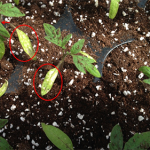
This is the time of year when growers often call to complain about tomato transplants that do not look right. One possibility is that the seedlings suffer from heater problems. In particular, tomato plants are very susceptible to damage from the gas ethylene. In Figure 1, some of the seedlings have leaves that are curled down and stems that are twisted (epinasty in…Read more about Ethylene Damage on Tomato[Read More]
As you all know, many of our vegetable crops are dependent upon pollinators to move pollen from flower to flower. The cucurbits, muskmelons, cucumbers, watermelons, pumpkins, and squash, are completely dependent on insect pollination. Eggplant, okra, lima beans, and peppers will set fruit without pollinators but can have increased yield if pollinators are present. Honey…Read more about Honey Bees and Other Pollinators[Read More]
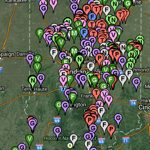
Vegetable, fruit, and organic farmers can register their production areas on Driftwatch.org to let commercial pesticide applicators know where the fields are. Beekeepers can also register sites where beehives are located. Once sites are registered and approved they appear on the Driftwatch registry map (see Fig. 1) and partnering applicators are notified. This helps applicators…Read more about Are Your Fields Listed at Driftwatch.org?[Read More]
Purdue University prohibits discrimination against any member of the University community on the basis of race, religion, color, sex, age, national origin or ancestry, genetic information, marital status, parental status, sexual orientation, gender identity and expression, disability, or status as a veteran. This material may be available in alternative formats. 1-888-EXT-INFO Disclaimer: Reference to products in this publication is not intended to be an endorsement to the exclusion of others which may have similar uses. Any person using products listed in this publication assumes full responsibility for their use in accordance with current directions of the manufacturer.