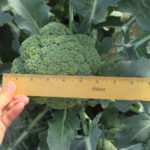
A fall broccoli trial was conducted in a high tunnel at Southwest Purdue Ag Center in 2016 to test the potential of growing broccoli in high tunnels after tomatoes. This article describes what we found from the trial. Broccoli is a cool-season, frost-tolerant crop. The harvest portion of broccoli is the compact, slightly dome-shaped head…Read more about Fall Broccoli Production in High Tunnels[Read More]
Cole Crops

There are three important caterpillar pests of crucifers in Indiana, the imported cabbageworm, the cabbage looper, and the diamondback moth. Each of these caterpillars will feed on leaves and heads. All are capable of producing serious damage to most crucifers. The adult imported cabbageworm is a common white butterfly with black spots on the forewing…Read more about Caterpillars in Crucifers[Read More]
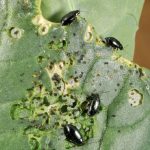
Many of our vegetable crops are attacked by one or more species of flea beetles (Figure 1). All species do similar types of damage, chewing small holes in the leaves. Damage is most important on young plants or transplants, so growers should watch young plants carefully. Fortunately, flea beetles are easy to control. Sevin®, the…Read more about Flea Beetles[Read More]
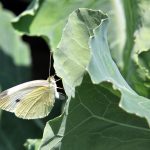
Crucifers such as cabbage, cauliflower, and broccoli are frequently attacked by a variety of caterpillars, with the most important being the imported cabbageworm, diamondback moth, and cabbage looper. The first caterpillar pest to attack crucifers is the imported cabbageworm. The adult stage is the common white butterfly that you will see flying around your field…Read more about Cabbage Caterpillars[Read More]
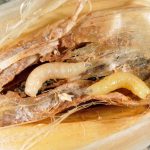
Three species of seed and root maggots attack vegetables in Indiana. The seedcorn maggot (Figure 1) feeds on seeds and seedlings of sweetcorn, cucurbits, lima and snap beans, peas, and other crops. Cabbage maggots can cause serious damage to transplants of cabbage, broccoli, cauliflower, and Brussels sprouts and make the fleshy roots of radishes, turnips,…Read more about Seed and Root Maggots[Read More]
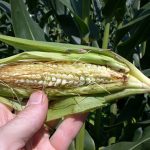
I have seen more green stink bugs this year than at any time in my career. I have no logical explanation for their abundance. It was thought that as the invasive brown marmorated stink bug became established, it might outcompete the native stink bugs such as the green stink bug, causing numbers to decrease. However,…Read more about Green Stink Bug[Read More]
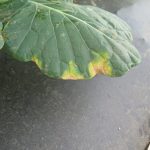
Cabbage is the crop most often affected by black rot, however, other crucifers such as broccoli, cauliflower, mustard, kohlrabi or Brussels sprouts may be affected. The first symptom one is likely to notice is a ‘V’ shaped lesion on the margin of the leaf (Figure 1). However, the symptom on Brussels sprouts observed recently are irregular, jagged…Read more about Black Rot of Crucifers[Read More]
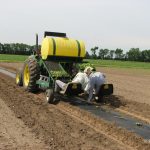
Getting seedlings from the transplant tray into the field is essential for a good crop (Figure 1). Healthy transplants treated well will quickly establish themselves in the field, setting the foundation for a productive crop. Here I offer some suggestions for successful transplant establishment. Harden transplants by exposing them to higher light, cooler temperature, and…Read more about Successful Transplant Establishment[Read More]
The cool, wet weather we have been having is perfect for the root and seed maggots in early planted vegetables. I have already received calls about onion maggots. If you are planting early vegetables, check out the article in the March 17, 2015, issue of the Hotline for 2015. So, how do we define early…Read more about Root and Seed Maggots[Read More]
Three species of seed and root maggots attack vegetables in Indiana. The seedcorn maggot feeds on seeds and seedlings of sweet corn, cucurbits, lima and snap beans, peas, and other crops. Cabbage maggots can cause serious damage to transplants of cabbage, broccoli, cauliflower, and Brussels sprouts and make the fleshy roots of radishes, turnips, and…Read more about Seed and Root Maggots[Read More]