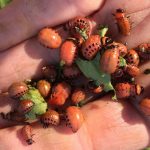
Last week we had a report of an infestation of Colorado potato beetle larvae on tomatoes in a high tunnel (Figure 1). Potato beetles are a pest of most of the solanaceous crops (potato, tomato, eggplant, pepper), but they rarely become a serious problem on tomato in Indiana. In addition, we have not seen them in…Read more about Colorado Potato Beetles on High Tunnel Tomatoes[Read More]
Solanaceous Crops
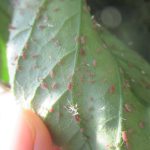
We have begun to receive the first reports of aphid outbreaks in high tunnels on tomato, pepper, and cucumber (Figure 1). Aphids are a very common problem in high tunnels because the covering excludes rainfall, which is a major mortality factor for small insects like aphids. Some growers are interested in using biological control in…Read more about Aphids in High Tunnels[Read More]
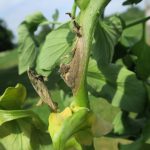
I have observed leaf mold of tomato in greenhouses and high tunnels recently. This article will discuss this disease and management options. In the last issue of the Hotline, I discussed Botrytis gray mold. I noted how gray mold is favored by the cool, cloudy weather we experienced earlier this spring. The warmer and sunnier weather we have…Read more about Leaf Mold of Tomato[Read More]

We recently published an article in the Hotline about gray mold of tomato. That article and more details about this disease can be found here. In this short note, we want to share examples of the relationship of gray mold and tomato plant injury. In the figure 1 above, a pruning injury of tomato in a commercial…Read more about Plant Injury and Gray Mold[Read More]
Read more about Plant Injury and Gray Mold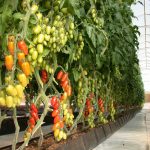
Planting density plays an important role in the optimization of labor efficiency and productivity of your high tunnel. For the purpose of this article I will focus on tomato which is commonly grown as a high value crop on small farming operations. Usually growers select varieties according to customer (market) preference and then try to…Read more about Link between Plant Density, Yield and Revenue from a High Tunnel[Read More]
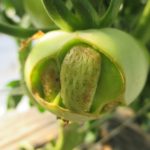
Recent cool weather increases the occurrence of zippering on high tunnel tomatoes. We observed at least 20% of developing fruit (most on the first and second flower clusters) on the variety Mountain Spring showed the zippering symptoms in our high tunnel. A typical symptom of the disorder is a thin, brown, necrotic scar that starts from the…Read more about Tomato Zippering[Read More]
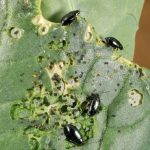
Many of our vegetable crops are subject to feeding by one or more species of flea beetles (Figure 1). Flea beetles get their name because they have enlarged hind legs that allow them to jump like fleas. Most species are quite small, and with their ability to jump, often seem to just disappear when disturbed….Read more about Flea Beetles[Read More]
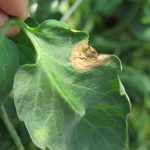
The recent cool and cloudy weather has influenced conditions in the field as well as in greenhouses and high tunnels. I have observed more Botrytis gray mold of tomatoes in greenhouses this spring than usual. This is due in part to the weather. This article will discuss this disease on tomatoes and some management options….Read more about Botrytis Gray Mold on Greenhouse Tomatoes[Read More]
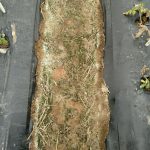
In a recent visit to a high tunnel, we observed a severe salinity problem on tomatoes. Approximately one month after planting , most tomato plants in the affected area had not sent out any new leaves. Roots did not grow at all (Figure 1). After conducting a soil test, very high soluble salt level explains…Read more about Salt Accumulation for Vegetable Production in High Tunnels[Read More]
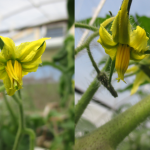
Maintaining temperature in the ideal range is very important for tomato fruit set. The optimum temperatures are 60-75°F (night) and 60-90°F (day). Studies showed that exposing plants to 3-h periods of temperatures above 104°F on two successive days may caused fruit set failure. Not only is the maximal temperature critical for fruit set, maintaining night temperature…Read more about Understanding High Temperature Effects on Fruit Set of Tomatoes[Read More]