
As spring brings life back into our high tunnels, it also awakens more than just our crops. This year, our spinach beds became an early battleground in the age-old story between pests and their natural enemies. From the first warm days, we began spotting tiny green aphids clustering on young spinach leaves, sucking sap, and…Read more about Tiny Allies in the Tunnels[Read More]
Spinach
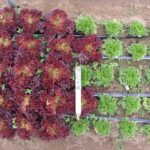
When we surveyed Indiana high tunnel producers eight years ago, about two-thirds of the operations grew cool season crops for harvest from November to March. Although spring field planting season is just underway, it is not too early to plan for markets and organize a production schedule for fall. This article summarizes common crops and…Read more about Planning for Fall and Winter Production in High Tunnels[Read More]

A common approach in winter production is to allow crops to reach maturity or harvestable size by the end of November. High tunnels are then used as a ‘living refrigerator’ from December to around the middle of February. Crops are harvested as needed in the darkest and coldest periods. This approach, however, did not work…Read more about Low Temperatures in December Hurt January and February Markets[Read More]
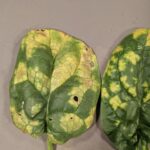
Downy mildew of spinach can be an important disease of spinach. The lesions are often a bright yellow with irregular margins (Figure 1). With time, these lesions can become a light brown. The underside of the lesion is dark black or purple under moist conditions. Under very conducive conditions, sporulation can occur on the top…Read more about Downy Mildew of Spinach[Read More]
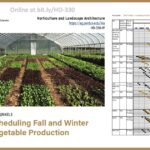
A new bulletin “Scheduling Fall and Winter Vegetable Production in High Tunnels” is available from the Purdue Education store at https://edustore.purdue.edu/item.asp?Item_Number=HO-330-W . The publication brings together information collected on farms and research stations in Indiana and Ohio to provide detailed guidance on scheduling vegetable crops for winter high tunnel production. It includes a fillable scheduling…Read more about Scheduling Fall and Winter Vegetable Production in High Tunnels[Read More]
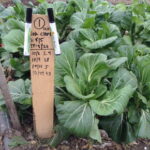
A lot of things are different this year. With the changes come opportunities to try something new. Liz Brownlee with Hoosier Young Farmers Coalition mentioned to me that some markets, especially in rural areas, do not have a steady supply of Fall crops, and that farmers might be looking to extend the season with crops…Read more about Is This the Year to Try Fall Crops?[Read More]
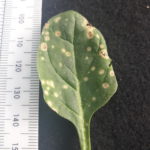
While many growers use high tunnels to extend the growing period for warm-season crops such as tomatoes or cucumbers, it is also possible to grow cool-season crops such as spinach well into winter. The winter over much of Indiana has been rather mild; spinach and other cool-season crops should be doing well. However, disease and…Read more about Cladosporium of Spinach[Read More]
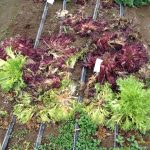
Some of the red and green multi-leaf lettuce plants in Figure 1 are wilted and closer inspection reveals death and soft decay at the crown and well as freeze damage (Figure 2). Getting even closer as in Figure 3 we see white fuzzy mold and find hard black sclerotia 1/8 to ¼ inch across and…Read more about Problems in Overwintered Salad Greens – White Mold and Tip Burn[Read More]
Do you grow spinach or lettuce in Northwest Indiana? Drs. Lindsay Gielda and Scott Bates in the Dept. of Biological Sciences at Purdue University Northwest would like to collect a few samples from your farm. They are studying how the endosymbiotic fungi that naturally live on spinach and lettuce might inhibit the growth of pathogenic E. coli strains…Read more about Researchers Looking for Spinach and Lettuce from NW Indiana[Read More]