Indiana State Department of Agriculture/Indiana Grown was recently awarded a grant in partnership with the Indiana State Department of Health, Indiana Dept of Education and Purdue Extension to create an all-inclusive local food sourcing guide for schools, called Indiana Grown for Schools: School Food Service Resource Guide. This two-year project will start with gathering information…Read more about Farm to School Survey[Read More]
Beginning in August, Purdue Extension will offer produce food safety trainings throughout Indiana. The trainings utilize the Produce Safety Alliance (PSA) training curriculum and will be offered at multiple locations across the state. For produce farms that are covered under the Food Safety Modernization Act Produce Safety Rule, at least one manager or responsible person…Read more about Purdue Extension Offers Produce Food Safety Training Across Indiana[Read More]
The On Farm Readiness Review (OFRR) is now available and being offered to Indiana produce growers. The OFRR is a VOLUNTARY assessment of your farm’s readiness to be in compliance with the Produce Safety Rule. This is not an audit or inspection, but a chance for you to have a team of reviewers visit your…Read more about On Farm Readiness Review is Available for Growers[Read More]
Many years ago, I was told that to successfully use fungicides on vegetables, one must use high spray pressures and hollow cone nozzles. However, I had trouble finding any research on this topic, just rumors. So, I did my own research. Dennis Nowaskie, Superintendent at the Southwest Purdue Agricultural Center (SWPAC) built a single row…Read more about Spray Pressure and Nozzle Type[Read More]
Since there is an article about the application of insecticides in this issue, below I list 10 rules that will help vegetable growers apply fungicides effectively and safely. Apply fungicides prior to the development of disease. Although many fungicides have systemic (“kick back”) action they will not completely eradicate diseases after they have started. And…Read more about 10 Useful Rules for Fungicide Applications[Read More]
It’s not uncommon for us to get calls from growers who are expressing concern about a particular insecticide product that is not working as well as the growers would like. Often, growers will suggest that Product X is no good or that the target insect has now developed resistance to that particular insecticide. Before we…Read more about Why Your Insecticide May Not Be Working as Well as You Would Like[Read More]
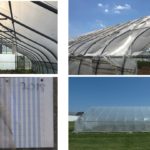
Have you ever wondered how much difference new plastic would make in terms of light getting to crops in a high tunnel? We replaced 6-year-old plastic on High Tunnel 1 at Pinney Purdue Ag Center last week. Figure 1 below shows the high tunnel before and after recovering, and pieces of the old and new…Read more about New Plastic Equals More Light in a High Tunnel[Read More]
Does your farm often have excess produce in your growing period? We would love to connect our volunteers to come and glean that produce and put it on a plate of someone who needs this fresh food! Gleaning America’s Fields – Feeding America’s Hungry. We do it simply, effectively, and efficiently. Since 1983, Society of…Read more about Society of St. Andrew Expands Gleaning in Indiana[Read More]
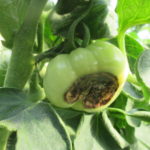
We recently received several calls reporting blossom end rot of tomatoes (Figure 1). Although blossom end rot is caused by deficient supply of calcium to the developing fruit. The occurrence of this physiological disorder often relates to inconsistent supply of water. As a general rule, vegetables require 1-1.5 acre-inches of water per week. Since there…Read more about Are You Applying Enough Water for Vegetables Grown in High Tunnels?[Read More]
