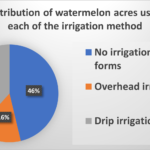
At the 2022 Southwest Indiana Melon and Vegetable Growers Annual Meeting, 17 watermelon farmers and 2 agricultural professionals shared their irrigation and fertilization management practices used for watermelon production in Indiana. These individuals grow or provide services for watermelon acres from less than 50 acres up to 2,000 acres over the past five years. We…Read more about Watermelon Irrigation and Nitrogen Fertilization Methods Commonly Used in Indiana[Read More]
Watermelon
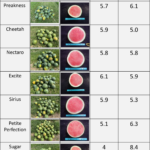
We conduct standard seedless watermelon variety trials at Southwest Purdue Agricultural Center each year. In a separate trial, we evaluate mini seedless watermelon varieties. Mini watermelons refer to fruit ranging from 4.4 to 8.8 lbs, although the industry considers 6-7 lbs fruits ideal. Fruit in a wide range of sizes is suitable to sell at…Read more about Mini Seedless Watermelon Varieties[Read More]
Date: November 18, 2021, 5:00 pm (EST) Location: 4207 Purdue Rd, Vincennes, IN 47591. Purdue Extension Food Safety Training Hub, in the newly constructed Vincennes University Agricultural Center, located on highway 41 adjacent to Southwest Purdue Agriculture Center. The Southwest Indiana Melon and Vegetable Growers Winter Meeting will be back in person in 2021! Note the new…Read more about Southwest Indiana Melon and Vegetable Growers Winter Meeting[Read More]
Supported by Indiana Vegetable Growers Association and Illiana Watermelon Association, a collaborative project between Purdue University and Michigan State University that aims to help watermelon farmers improve irrigation management was recently funded. In this project, the team will conduct the scientific experiment at the Southwest Purdue Agricultural Center to test currently used irrigation management tools,…Read more about Collaboration between Purdue University and Michigan State University to Improve Irrigation Management in Indiana Watermelon Production[Read More]
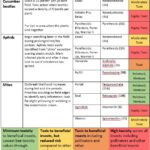
Unfortunately, pests don’t know when to take the day off. Even though we have bees in the field and watermelons reaching peak bloom, we still need to watch out for pest infestation and disease outbreaks. First and foremost, scouting fields to monitor pests will ensure that infestations never reach high enough populations to threaten yield….Read more about Spray Less, Pay Less, and Get Better Control of Your Arthropod Pests[Read More]
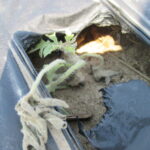
In early May, we had an extended cold period with daily average air temperatures in the 50s°F. Min temperatures are in the 40s°F, some nights even upper 30s°F. In most areas in southern Indiana, it is fortunate we did not encounter a frost with temperature dropped below 32°F, but the low temperature for the extended…Read more about Why do Watermelon and Melon Plants Wilt?[Read More]
MELCAST is a weather-based disease-forecasting program that helps growers schedule foliar fungicides applications for watermelon and cantaloupe. MELCAST stands for MELon disease for CASTer. This program, designed by Dr. Rick Latin, Professor of Plant Pathology at Purdue University, keeps track of weather conditions so that cantaloupe and watermelon growers can apply foliar fungicides to their…Read more about MELCAST 2021[Read More]
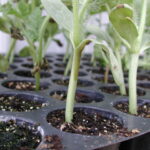
Many cantaloupe and watermelon growers are either growing transplants in a greenhouse or are expecting delivery of transplants in the next few weeks. Either way, growers should inspect transplants for disease before planting in the field. Below I will describe several common transplant diseases of cantaloupe and watermelon as well as management options. Gummy stem…Read more about Cantaloupe and Watermelon Transplant Diseases[Read More]

The Annual Fall/Winter Meeting of the Southwest Indiana Melon and Vegetable Growers is scheduled on Monday, November 30, 2020, 3:00 pm – 5:00 pm (EST). This meeting will be held online this year because of COVID-19 restrictions. Dr. Wenjing Guan and Dr. Dan Egel will discuss the results of the 2020 watermelon and cantaloupe variety…Read more about Southwest Indiana Melon and Vegetable Growers Winter Meeting[Read More]
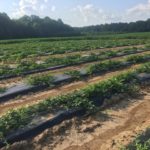
Thanks to growers’ collaboration and help from Superior Ag, we collected plant tissue samples from 12 watermelon fields at different crop growing stages in Southern Indiana in the 2020 season. In a previous article, we discussed results about magnesium and potassium. In this article, we will discuss another nutrient, Sulfur (S). Sulfur deficiency has become…Read more about Survey of Watermelon Nutritional Status in Southern Indiana – Sulfur[Read More]