Entomologists are looking for growers willing to participate in research examining the detection and distribution of striped cucumber beetles. We would like to visit your fields on multiple occasions this year to count the number of cucumber beetles we encounter in your crop. If you grow slicing cucumbers in the field, and are interested in helping to improve…Read more about Entomologists Looking for Cucumber Beetles[Read More]
Pests and Pest Management - General
References, associations, organizations, periodicals, pesticides, pesticide safety, pest laws and regulations
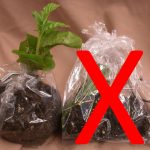
Samples in plug trays, as well as unrooted and rooted cuttings, and plants in pots require extra care when they are packaged for submittal to a diagnostic lab. Before you mail the next sample, please take a few minutes to review these suggestions for packaging and submitting samples. This will help preserve the integrity of…Read more about Tips for Submitting Greenhouse Samples to the Purdue Plant and Pest Diagnostic Lab (PPDL)[Read More]

Small vegetable growers may find pesticide applications with a tractor driven sprayers impractical. Such growers may turn to hand sprayers. In a separate article, I argued that garden sprayers are not appropriate for most commercial pesticide applications. In this article, I will discuss the use and calibration of a backpack sprayer, an excellent alternative to…Read more about Backpack Sprayer Use[Read More]
As part of a multi-state effort being headed by Dr. Ian Kaplan at Purdue University in the Department of Entomology, we are investigating how to best manage insect pests on cucurbits, in our case watermelons, while having the least possible impact on pollinators. The research is being funded through the USDA/NIFA Specialty Crop Research Initiative….Read more about Purdue Looking for Watermelon Growers to Collaborate on Research Study[Read More]
Vegetable growers are familiar with pesticide labels that specify how much of a product may be applied. As commercial growers, we usually think about such instructions as telling us how much pesticide is the right amount to apply to a crop to be effective. While such an interpretation is correct, there is more to the labeled rates…Read more about The Results are in: Pesticide Residues in Produce[Read More]
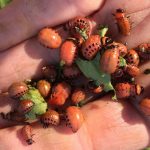
Last week we had a report of an infestation of Colorado potato beetle larvae on tomatoes in a high tunnel (Figure 1). Potato beetles are a pest of most of the solanaceous crops (potato, tomato, eggplant, pepper), but they rarely become a serious problem on tomato in Indiana. In addition, we have not seen them in…Read more about Colorado Potato Beetles on High Tunnel Tomatoes[Read More]
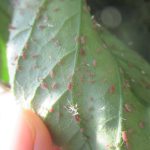
We have begun to receive the first reports of aphid outbreaks in high tunnels on tomato, pepper, and cucumber (Figure 1). Aphids are a very common problem in high tunnels because the covering excludes rainfall, which is a major mortality factor for small insects like aphids. Some growers are interested in using biological control in…Read more about Aphids in High Tunnels[Read More]
I continue to catch low numbers of corn earworm moths in my pheromone trap. Although the numbers are low, growers with very early sweet corn that is in the reproductive stage should be alert for potential damage. The threshold for spraying sweet corn that matures prior to field corn silking is only one moth per…Read more about Corn Earworm[Read More]
Purdue Extension publication PPP-110 ‘Options for Dealing with a Pesticide Drift Incident’ describes causes and effects of pesticide drift. It discusses actions a vegetable farmer (or anyone) might take if they suspect that herbicide drift may have injured their crop. The first step suggested is to find out what caused the symptoms. The publication explains…Read more about New Purdue Publication About Pesticide Drift[Read More]