Many vegetable growers are closing in on the final harvest. Several growers have asked me about fungicide applications late in the season. In this article, I want to address when to stop. To limit the scope of this article, I will concentrate on tomato, cantaloupe and watermelon crops. These are crops where the fruit is…Read more about When to Stop Spraying Fungicide[Read More]
Plant Disease Management
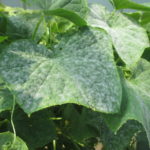
Powdery mildew is particularly severe in high tunnel and greenhouse growing conditions (Figure 1). It affects a wide range of crops including tomatoes and cucumbers. In addition to using synthetic fungicides to control this disease in high tunnels, we found powdery mildew on cucumbers can also be effectively controlled through variety selection and intensive plant…Read more about Variety Selection is Important for Managing Cucumber Powdery Mildew in High Tunnels[Read More]
Vegetable growers are used to scouting for pests such as spider mites and aphids. Growers have come to recognize the yellow leaves caused by spider mites and the curled leaves caused by aphids. Growers understand that even after spider mites and aphids are dead, the symptoms of the damage may remain on the affected leaves….Read more about Fungicides and Lesions[Read More]
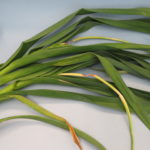
Earlier this summer, sunken lesions were observed on garlic scapes on a small farm in east central Indiana. Lesions started out a cream or tan color (Figure 1), however under rainy or humid conditions, spore production caused lesions to turn orange (Figure 2). Larger lesions resulted in the collapse of the scapes. It is estimated…Read more about Anthracnose of Garlic a New Disease to Indiana[Read More]
The 2019 production season started with above-normal rains. The wet conditions affected agriculture production, including watermelon and cantaloupe. In this article, we will review some of the watermelon and cantaloupe problems that are often associated with wet conditions. Manganese toxicity– This nutrient disorder occurs more often on cantaloupe that is grown in soils with pH…Read more about Results of Wet Condition on Watermelon and Cantaloupe[Read More]
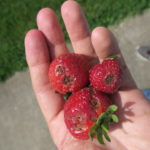
At the Southwest Purdue Ag Center, we are studying annual strawberry production on plastic mulch. Our hope is to gather information on the best methods and varieties to use for annual strawberry production in Indiana. As we learn about insect and disease problems, we will pass this information on to producers. This article is about…Read more about Strawberry Disease Update[Read More]
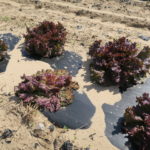
Although Indiana is not known for lettuce production, an increasing number of growers find that augmenting retail sales with leaf lettuce can be profitable. Since lettuce is a cool season crop, field planted leaf lettuce around Indiana may be reaching harvest stage. Leaf lettuce can generally be grown with few pests. However, lettuce drop was…Read more about Lettuce drop[Read More]
In response to the many questions about this disease on cucurbits, a new extension bulletin has been produced. The bulletin may be accessed at the link below. Or contact me to get your copy. https://www.extension.purdue.edu/extmedia/bp/bp-204-w.pdf
Ever year, I put together fungicide schedules for cucurbits. These may be found at purdue.ag/pumpkinfs and purdue.ag/melonfs. They may be downloaded as PDFs on legal sized pages. Please use these tables along with the MW Vegetable Production Guide and the fungicide label. If you have trouble with accessing the tables or have other questions. please…Read more about Fungicide Schedules[Read More]
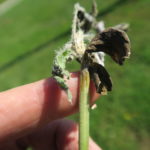
A recent observation of gummy stem blight on a watermelon transplant has reminded me to remind growers to inspect seedlings. Whether one is growing transplants or receiving transplants for delivery, seedlings should be inspected for possible disease problems. If one is uncertain of the cause of the symptoms, an official diagnosis can be obtained by…Read more about Watermelon Transplant Diseases[Read More]