Since there is an article about the application of insecticides in this issue, below I list 10 rules that will help vegetable growers apply fungicides effectively and safely. Apply fungicides prior to the development of disease. Although many fungicides have systemic (“kick back”) action they will not completely eradicate diseases after they have started. And…Read more about 10 Useful Rules for Fungicide Applications[Read More]
Plant Disease Management
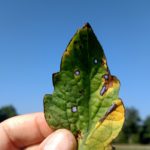
Bacterial spot of tomato has been observed across Indiana this summer. Leaf spots are usually 1/16 inch, and dark. Where lesions are numerous upon a leaf, the tissue may be chlorotic (yellow) (Figure 1 & 2). (In contrast, each lesion of bacterial speck is often accompanied by chlorosis whether lesions are numerous or not.) Lesions…Read more about Bacterial Spot of Tomato[Read More]
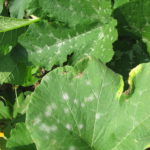
Powdery mildew is a common disease of cucurbits in Indiana. This disease is more common on cantaloupe and pumpkin. However, we have observed powdery mildew more frequently on watermelon in recent years. We have also observed this disease on cucumber in high tunnels. If left uncontrolled, this disease can cause loss of foliage, loss of…Read more about Powdery Mildew of Cucurbits[Read More]
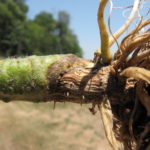
Below, I will briefly discuss a few of the diseases that I have observed on tomatoes recently. Powdery mildew of tomato – Powdery mildew of tomato is not usually a common problem in Indiana. However, in recent years, there have been more reports of this disease than usual. Powdery mildew is more often observed in a…Read more about Tomato Disease Update[Read More]
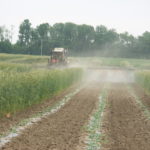
MELCAST is a weather-based disease-forecasting program that helps growers schedule foliar fungicides. MELCAST stands for MELon disease forCASTer. This program, designed by Dr. Rick Latin, Professor of Plant Pathology at Purdue University, keeps track of weather conditions so that cantaloupe and watermelon growers can apply foliar fungicides to their crops when they are most needed….Read more about MELCAST 2018[Read More]
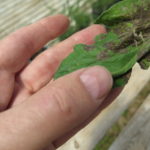
I recently encountered some lesions of Tomato Spotted Wilt Virus (TSWV) that appeared relatively large and had a ring-like structure. I was able to confirm the presence of the virus, but at first glance, the lesions could be mistaken for a very common tomato disease: early blight. This article will describe how the foliar lesions…Read more about Tomato Lesion Primer[Read More]
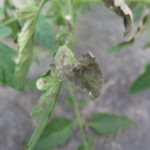
While many virus diseases affect pepper and tomato plants, in the Midwest, the most common virus diseases of these two crops are tomato spotted wilt virus (TSWV) and Impatiens necrotic spot virus (INSV). These diseases are usually observed in greenhouse or high tunnel situations. The two viruses, TSWV and INSV are closely related. In fact,…Read more about Tomato Viruses in Greenhouse[Read More]
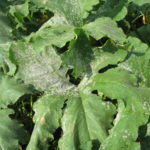
Powdery mildew is a foliar disease of all plants in the cucurbit family. The talc-like symptoms on leaves are relatively easy to identify (Figure 1). More about powdery mildew of cucurbits can be found at this link https://vegcropshotline.org//article/powdery-mildew-of-cucurbits-2/. The remainder of this article is an update. There are several systemic fungicides which are recommended for powdery…Read more about Powdery Mildew of Cucurbits Update[Read More]
The Midwest Vegetable Production Guide for Commercial Growers 2018 described above is a good way to keep up with what fungicides are recommended and their proper use. Last year, I developed a fungicide schedule to help growers schedule when fungicides are applied. These fungicide schedules seemed to be popular, so I have updated the fungicide…Read more about Fungicide Schedules[Read More]
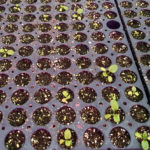
This is the time of year when growers begin planting seed—whether you are child planting a few seeds in Dixie cup for a school project, home tomato growers, or professional horticulturists. Unfortunately, one problem you may share in common is damping-off. Damping-off describes the death of seeds or seedlings and includes all of the following…Read more about Damping-off[Read More]