Many cantaloupe and watermelon growers have transplanted seedlings to the field. Soon, these growers will have questions about what and when to apply fungicides. The article below in this issue of the Vegetable Crops Hotline will address what fungicides to apply (Fungicides schedules for cucurbits). This article discusses when to apply fungicides with the MELCAST system….Read more about MELCAST 2017[Read More]
Plant Disease Management
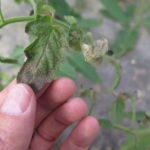
Tomato spotted wilt virus can cause stunting (Figure 1), necrotic ring spots (Figure 2), mottling (Figure 3) or chlorosis (Figure 4). In Figure 5, a pepper plant is shown with a ring-like lesion due to tomato spotted wilt virus. Figure 6 is a photo of a pepper transplant with mottled lesions due to impatiens necrotic…Read more about Photos of Tomato Spotted Wilt and Impatiens Necrotic Spot Virus[Read More]
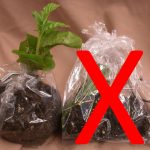
Samples in plug trays, as well as unrooted and rooted cuttings, and plants in pots require extra care when they are packaged for submittal to a diagnostic lab. Before you mail the next sample, please take a few minutes to review these suggestions for packaging and submitting samples. This will help preserve the integrity of…Read more about Tips for Submitting Greenhouse Samples to the Purdue Plant and Pest Diagnostic Lab (PPDL)[Read More]
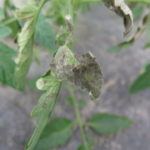
While many virus diseases affect pepper and tomato plants, in the Midwest, the most common virus diseases of these two crops are tomato spotted wilt virus (TSWV) and Impatiens necrotic spot virus (INVV). These diseases are usually observed in greenhouse or high tunnel situations. The two viruses, TSWV and INSV are closely related. In fact,…Read more about Viruses on Greenhouse Tomatoes[Read More]
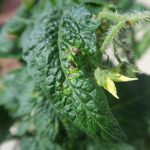
Many Indiana growers may have tomato transplants growing in a greenhouse for field or greenhouse/high tunnel production. The three most likely diseases are bacterial spot, bacterial speck and bacterial canker. This article describes symptoms for these diseases and some management options. While these bacterial diseases thrive in transplant production where plants are often overhead watered, these diseases are…Read more about Tomato Transplant Diseases[Read More]
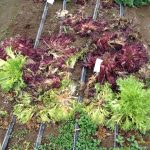
Some of the red and green multi-leaf lettuce plants in Figure 1 are wilted and closer inspection reveals death and soft decay at the crown and well as freeze damage (Figure 2). Getting even closer as in Figure 3 we see white fuzzy mold and find hard black sclerotia 1/8 to ¼ inch across and…Read more about Problems in Overwintered Salad Greens – White Mold and Tip Burn[Read More]
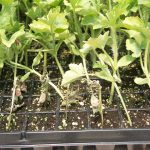
Fusarium wilt is one of the most serious diseases of watermelon in the Midwest. The disease often causes a one-sided wilt 2-3 weeks after transplanting. Whether a plant is affected, and to what degree, depends on the population of the long-lived spores in the soil that the roots contact. However, Fusarium wilt of watermelon is…Read more about Evidence for Spread of Fusarium Wilt of Watermelon in Transplant Trays[Read More]
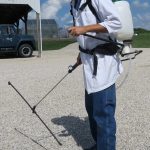
The use of tractor drawn pesticide sprayers is not practical for many smaller growers. Two alternatives are garden-sprayers or backpack sprayers. I will argue here that garden-sprayers are not suited for most commercial pesticide use. The typical garden sprayer that may be found at a garden shop or hardware store usually has a 1 or…Read more about Garden Sprayer vs Backpack Sprayer[Read More]
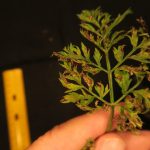
Last fall, my lab received a carrot sample with disease-like lesions (Figures 1 and 2). There are at least 3 carrot diseases that may appear similar. These diseases are: Alternaria leaf blight (late blight), Cercospora leaf spot (early blight) and bacterial leaf blight. Often an examination in the laboratory is necessary. My examination revealed the characteristic spores…Read more about Alternaria Leaf Blight of Carrot[Read More]
As Indiana growers finish up the 2017 season, it is important to remember to clean and sanitize equipment and tools. In this article, I would like to discuss the importance of and how to sanitize. Bacteria and fungi that cause plant disease may survive on some types of equipment. Examples include: stakes, transplant trays, shovels, greenhouse…Read more about Fall Clean and Sanitize[Read More]