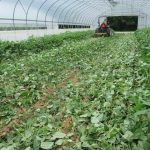
We have grown strawberries from Aug, 2015 to May, 2016 in one of our high tunnels at Southwest Purdue Agricultural Center. After taking the strawberry plants out of the high tunnel in the end of May, we did have enough time to grow a warm-season crop, like cucumbers. However, because for most of us June…Read more about A Case Study: What Cover Crops Could Achieve in High Tunnels in the Middle of Summer?[Read More]
Soil Fertility and Fertilizers
Soil nutrients, plant nutrition, soil testing and sampling, soil acidity, soil organic matter, green manures and cover crops, animal manures, fertilizer recommendations, fertilizer materials, etc.
We sometimes hear that excessive nitrogen could delay fruit set, stimulate excessive vine growth, and depress overall yield of pumpkins, but it is often unclear how much nitrogen is too much. This article reviews research on nitrogen fertilizer rates for pumpkins, and discusses the potential factors that might affect the recommended nitrogen rate. In a…Read more about How Much Nitrogen is Too Much for Pumpkins[Read More]
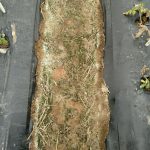
In a recent visit to a high tunnel, we observed a severe salinity problem on tomatoes. Approximately one month after planting , most tomato plants in the affected area had not sent out any new leaves. Roots did not grow at all (Figure 1). After conducting a soil test, very high soluble salt level explains…Read more about Salt Accumulation for Vegetable Production in High Tunnels[Read More]
Census data showed that in 2014 Indiana (12 acres), Illinois (11 acres) and Kentucky (13 acres) dedicated a very small portion of their food crop acreage to production under protection. According to the USDA National Agriculture Statistical Service 2014 Horticulture Specialties Census, of all the states surrounding Indiana, Ohio and Michigan have grown and sold…Read more about Importance of Water and Soil Analysis for High Tunnel Growers[Read More]
Soil pH plays an important role in plant nutrition. However, we might not be familiar with how nitrogen fertilizers influence soil pH over time. This article explains how nitrogen fertilizers influence soil pH over time and discusses some considerations in choosing N fertilizers. Plants can take up N in two forms: ammonium and nitrate. Ammonium…Read more about Effects of Nitrogen Fertilizers on Soil pH[Read More]
There are certain questions within our culture for which there are simply no good answers. For example, how many times have we heard the classic question, “If a tree falls in a woods and there’s no one to hear it, does it still make a sound?” One question I’ve been asked recently, for which the…Read more about Managing Manure – How Long is Long Enough?[Read More]
Crop production, decomposition of organic matter, using ammonium-producing nitrogen fertilizers, and rainfall all lower soil pH. To maintain soil pH in the optimal range (6.5 to 6.8) for vegetable production, periodic application of lime is needed. The primary form of agricultural lime is calcium carbonate (CaCO3). It is the carbonate (CO3^2-) part that brings up…Read more about Liming[Read More]
You might remember seeing cation exchange capacity in soil test reports. Recently, I have been asked about what it means. This is one of the important soil characteristics that we need to understand. Firstly, we need to know what cations are. Cations are positively charged ions. There are several. The ones very important for plant…Read more about Cation Exchange Capacity (CEC): What Does It Mean?[Read More]
Pumpkins are off to good start and vines are starting to run, which means it is time to think about making a sidedress application of nitrogen. Typically, I recommend to split nitrogen applications half preplant and half sidedress. This is especially beneficial given all of our rain this season. If you relied on preplant N alone, with…Read more about Mid-Season Nitrogen Management in Pumpkins[Read More]
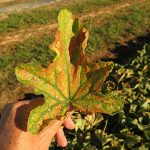
I have observed many fields of cantaloupes with magnesium deficiency or manganese toxicity. Watermelon plants may exhibit similar symptoms, but not as frequently as cantaloupe. Both disorders are related to acid (low pH) soils and usually occur in clusters in a field. Magnesium deficiency usually appears on sandy ridges and can be recognized by interveinal…Read more about Magnesium and Manganese in Melon[Read More]