
Dr. Wenjing Guan comes to Purdue from North Carolina Agricultural and Technical State University, where she was a Horticultural Specialist working on season extension for vegetable production. She was involved in research projects to establish planting calendars for organically produced warm season (tomato, cucumber and pepper) and cool season (lettuce, spinach and pak choi) vegetables…Read more about Welcome Dr. Wenjing Guan[Read More]
Found 129 Articles
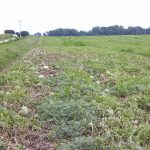
Protecting vegetable crops from foliar disease involves many factors. Crop rotation and fall tillage will help to lessen disease severity. Choosing a resistant or partially resistant variety can lower the amount of disease. Purchasing seed that has been tested for seed borne disease is also an important factor. Most growers, however, find it is also…Read more about To Spray or Not To Spray[Read More]
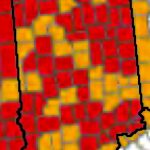
On August 12, 2015, USDA designated 88 counties in Indiana as natural disaster areas due to heavy rainfall since May. The four counties not designated disaster areas are LaGrange, Perry, Spencer and Steuben. Farm operators in the ‘disaster’ counties are eligible for low interest emergency loans from the Farm Service Agency, provided they meet…Read more about USDA Designates Disaster Areas in Indiana[Read More]
Code Red Webinar. Thursday, August 27, 2015. 12:00 P.M. – 1:00 P.M. EDT. The Code Red tool developed by the Purdue Women in Agriculture Team is a must have for every family, business, and farm operation. The tool includes important information such as passwords, bank account information, rental agreements, insurance papers, power of attorney documents,…Read more about Upcoming Events[Read More]
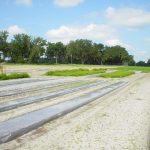
Tomato growers who utilize high tunnels to reach early markets often find that there are few economic alternatives to tomato. Therefore, many growers grow tomatoes after tomatoes instead of rotating to a different crop. The repeated cropping of tomato in the same area can lead to disease problems such as Fusarium crown rot and white…Read more about Soil Solarization[Read More]
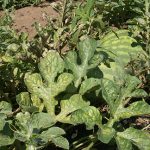
We have received a number of reports of outbreaks of spider mites, primarily in watermelons and in high tunnels. The problems in high tunnels are not unexpected because one of the primary causes of mortality in mite populations is rainfall washing them off the plants and, of course, that is lacking completely in high tunnels….Read more about Spider Mites[Read More]
Pheromone trap catches for corn earworms continue to be very low. Again, this is a time when growers can save a lot of money and time by monitoring their pheromone traps and not spraying. I harvested untreated sweet corn on Friday, July 31, and had over 98% clean ears and the few that were damaged…Read more about Corn Earworm[Read More]
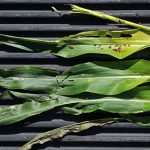
Fall armyworms have completed their annual trek from the Gulf Coast to the Midwest. Fall armyworm larvae will feed on all aboveground parts of the sweet corn plant, during all stages of growth. The damage to the foliage is much more severe than with European corn borer. Larvae will feed from within the whorl of…Read more about Fall Armyworm[Read More]
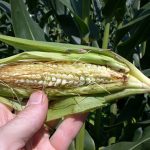
I have seen more green stink bugs this year than at any time in my career. I have no logical explanation for their abundance. It was thought that as the invasive brown marmorated stink bug became established, it might outcompete the native stink bugs such as the green stink bug, causing numbers to decrease. However,…Read more about Green Stink Bug[Read More]
Growers should remember as of July 31, 2015, it is illegal to use endosulfan on any crop other than pineapple or strawberry. By July 31, 2016, all use of this product will be cancelled. Endosulfan in an organochlorine insecticide, the same class as DDT, and was first produced in the US in 1954. It has…Read more about Goodbye Endosulfan[Read More]
Purdue University prohibits discrimination against any member of the University community on the basis of race, religion, color, sex, age, national origin or ancestry, genetic information, marital status, parental status, sexual orientation, gender identity and expression, disability, or status as a veteran. This material may be available in alternative formats. 1-888-EXT-INFO Disclaimer: Reference to products in this publication is not intended to be an endorsement to the exclusion of others which may have similar uses. Any person using products listed in this publication assumes full responsibility for their use in accordance with current directions of the manufacturer.