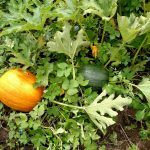
Several pumpkin growers have asked me when to stop managing for pumpkin diseases. That is, when should a pumpkin grower stop applying fungicides? I cannot provide a definitive answer for this question; every grower will have to make his or her own decision. Below, however, are some factors to consider. Estimate the crop yield-walk through the field and…Read more about Late Season Pumpkin Disease Management[Read More]
Pumpkins
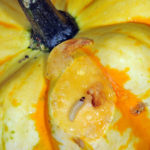
Many of us may forget about the pesky squash vine borer until it’s too late. This pest of cucurbit crops tends to be sporadic in our region; you are either battling it every year or it hardly makes an appearance. The squash vine borer is a member of the clear-winged moths, a unique group of…Read more about What’s Eating my Squash?[Read More]
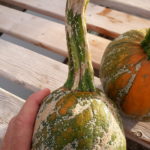
Before writing this article, I went back to an old article from 2015. In 2015, I had written, Plectosporium blight was more severe than normal. In 2018, I have also observed more Plectosporium blight than usual. It is not clear to me why this disease seems to be more widespread compared to recent seasons. However,…Read more about Plectosporium Blight of Pumpkins[Read More]
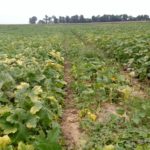
This time of year, I receive many complaints of pumpkin plants with yellow leaves. There can be many reasons why pumpkin plants have yellow leaves. The most common reason for yellow pumpkin leaves doesn’t have anything to do with a disease that can spread from plant to plant. Usually, the reason for the yellow pumpkin…Read more about Yellow Leaves on Pumpkins[Read More]

One of the most common diseases of pumpkin in Indiana is powdery mildew. Growers are naturally anxious to observe whether the fungicide they have been applying for this disease has been effective. Therefore, many pumpkin growers scout their fields for disease. Although powdery mildew is relatively easy to recognize, it is possible to become confused. …Read more about Powdery Mildew Symptoms vs Variegated Leaves[Read More]
Read more about Powdery Mildew Symptoms vs Variegated Leaves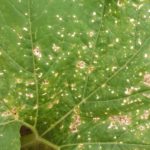
I have observed this disease in scattered commercial pumpkin and squash fields across Indiana. Bacterial leaf spot of pumpkin is perhaps the most serious disease of pumpkin in Indiana today. Symptoms: Bacterial spot causes ⅛-¼ inch angular leaf lesions that are white to light brown in color (Figure 1). These leaf lesions may be accompanied…Read more about Bacterial Spot of Pumpkin[Read More]
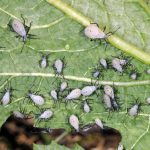
Squash bug is the most consistent insect pest of squash and pumpkins and is the most difficult to control (Figure 1 and 2). The key to management is early detection and control of the nymphs. The adults are extremely difficult to kill. Foliar insecticides should be applied to control the nymphs when you have more…Read more about Squash Bugs[Read More]
With the start of pumpkin harvest, it is a good time to review important considerations for harvest and postharvest storage of pumpkins and winter squash (butternut, acorn and hubbard squash etc.). First, pumpkin and winter squash should be harvested fully mature to reach their optimal quality and fulfill their potential for long shelf lives. Characters…Read more about Harvest and Postharvest Storage of Pumpkins and Winter Squash[Read More]
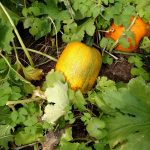
Several pumpkin growers have asked me when to stop managing for pumpkin diseases. That is, when should a pumpkin grower stop applying fungicides? I cannot provide a definitive answer for this question; every grower will have to make his or her own decision. Below, however, are some factors to consider. Estimate the crop yield – walk through the…Read more about Late Season Pumpkin Disease Management[Read More]
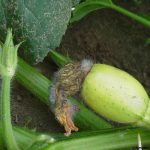
There has been some concern about poor fruit set in pumpkin fields that otherwise have healthy vigorous vines. This summer we have experienced above normal temperatures for much of the pumpkin fruit set season and I suspect that has played a role. This article will consider temperature as well as other factors that influence pumpkin…Read more about Pumpkin Fruit Set[Read More]