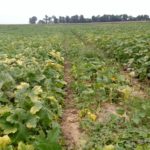
In the last several days I have received complaints of pumpkin plants with yellow leaves. Growers want to know if the yellow is a symptom of disease and what can be done about it. Yellow lesions on leaves may be symptoms of disease. There can be many reasons why pumpkin plants have yellow leaves. Usually,…Read more about Yellow Leaves on Pumpkin[Read More]
Pumpkins
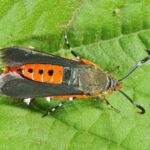
For some, we may often forget about the pesky squash vine borer until it’s too late. This pest of cucurbit crops tends to be sporadic in our region; you are either battling it every year or it hardly makes an appearance. And, unfortunately, our urban farmers tend to get hammered. While it is not so…Read more about Time to Scout for Squash Vine Borer (SVB)[Read More]
Pumpkin planting is right around the corner. The recent Vegetable Beet Podcast produced by Great Lakes Vegetable Producers Network featured Brad Bergefurd from The Ohio State University and Nathan Johanning from University of Illinois talking about Pre-season Pumpkin Tips. They shared many of their insights in planting spacing, fertility management, weed control, no-till etc. A…Read more about Pumpkin Resources[Read More]
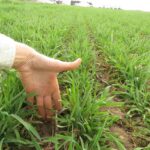
In a recent Hoosier Ag Today/CCSI Soil Health Podcast, Stephen Meyers of Purdue Horticulture and Dan Perkins of Perkins Good Earth Farm covered spring management of cover crops on vegetable farms. They discussed a variety of methods for terminating: flail mowing and tarping, roller-crimping, tillage, and killing with herbicide. They pointed out that decisions about…Read more about Cover Crops in May: Soil Health Podcast on Spring Management and Observations of Winter Rye at Pinney Purdue[Read More]
At the Pinney Purdue Ag Center in northern Indiana we had plots in 2020 with no-till sweet corn, pumpkins and winter squash following a rye cover crop. As is common when adapting new planting and tillage systems, we had both challenges and successes. Check out the video presentations to see photos of the plots, and…Read more about No-till Sweet Corn, Pumpkin and Winter Squash after Winter Rye – Reports from 2020[Read More]
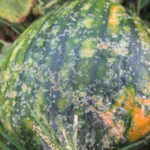
This time of year you are likely getting bogged down in the fight against pests. The accumulation of plant pathogens, insects, and climatic conditions favoring their growth can make the last few weeks of harvest feel like the toughest point in the battle. For cucurbit growers in particular, there are a number of insect pests…Read more about Cucumber Beetles Just Don’t Quit![Read More]
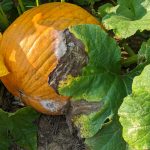
Phytophthora blight was a serious disease this past season. As a result, I have had many questions about managing this disease. The following article is an update of a previous article on this subject. The questions I have been asked have ranged from what do I spray to how does this disease work? Therefore, I…Read more about Phytophthora Blight of Cucurbits[Read More]
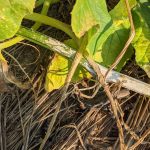
This disease appears to be more important each year. It is not clear to me why. This article reviews Plectosporium of pumpkin, sometimes called white speck. I would rank Plectosporium blight behind powdery mildew, bacterial leaf spot and Phytophthora blight in economic damage caused. The occurrence of this disease is usually sporadic. However, when it…Read more about Plectosporium blight of Pumpkin[Read More]
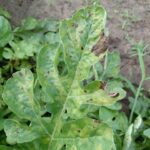
Downy mildew has been observed in LaPorte County in northern Indiana on cucumber. In addition, downy mildew on cucumber has been reported in southern Kentucky and on watermelon in the Kansas City area of Kansas. Growers in northern Indiana should manage for downy mildew on valuable cucurbit crops (Figure 1). Growers throughout the state should…Read more about Cucurbit Downy Mildew[Read More]