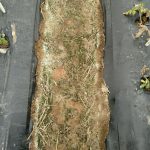
I visited a few high tunnels around the state recently and used a hand-held soil electrical conductivity (EC) meter to test soil salinity levels inside of the structures. Although the hand-held EC meter may not give ratings as accurate as a soil test lab could provide, I had comparative ratings from several farms. Interestingly, by talking…Read more about High Salinity Levels May Affect Tomato Production in High Tunnels[Read More]
Tomato
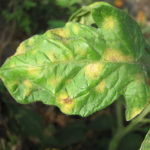
In the fall of 2015, I wrote an article for the Hotline about Cercospora leaf mold of tomato since this disease had been observed twice in the 2015 season. I wrote that Cercospora leaf mold was normally a subtropical disease. There have been several observations of Cercospora leaf mold on tomato in Indiana this year….Read more about Tomato Leaf Mold Diseases[Read More]
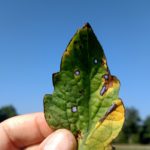
Bacterial spot of tomato has been observed across Indiana this summer. Leaf spots are usually 1/16 inch, and dark. Where lesions are numerous upon a leaf, the tissue may be chlorotic (yellow) (Figure 1 & 2). (In contrast, each lesion of bacterial speck is often accompanied by chlorosis whether lesions are numerous or not.) Lesions…Read more about Bacterial Spot of Tomato[Read More]
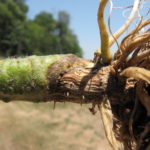
Below, I will briefly discuss a few of the diseases that I have observed on tomatoes recently. Powdery mildew of tomato – Powdery mildew of tomato is not usually a common problem in Indiana. However, in recent years, there have been more reports of this disease than usual. Powdery mildew is more often observed in a…Read more about Tomato Disease Update[Read More]
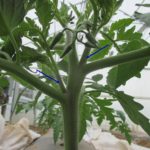
I have recently received a number of calls from growers about how to prune determinate tomatoes in a stake and weave system. Although this is relatively easy compared to how to prune indeterminate tomatoes with a trellis system, there are a few things I would like to call to your attention. What to prune The…Read more about Prune Determinate Tomatoes[Read More]
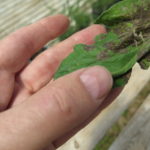
I recently encountered some lesions of Tomato Spotted Wilt Virus (TSWV) that appeared relatively large and had a ring-like structure. I was able to confirm the presence of the virus, but at first glance, the lesions could be mistaken for a very common tomato disease: early blight. This article will describe how the foliar lesions…Read more about Tomato Lesion Primer[Read More]
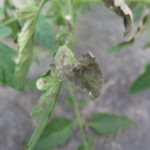
While many virus diseases affect pepper and tomato plants, in the Midwest, the most common virus diseases of these two crops are tomato spotted wilt virus (TSWV) and Impatiens necrotic spot virus (INSV). These diseases are usually observed in greenhouse or high tunnel situations. The two viruses, TSWV and INSV are closely related. In fact,…Read more about Tomato Viruses in Greenhouse[Read More]
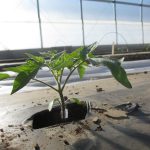
Awareness of tomato grafting has increased tremendously in the past years. Some growers fall in love with this technology and apply it to every tomato they grow. While others find this technology is not cost effective. The growers who have successfully adapted this technology are often small-scale, high tunnel or greenhouse growers who have mastered the grafting…Read more about Is it Economically Sound to Grow Grafted Tomatoes?[Read More]
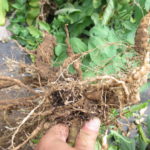
In a recent grower visit in southwest Indiana, we saw a severe root-knot nematode infestation on high tunnel tomatoes. Soil fumigation is by far the most effective approach to control nematodes, but many soil fumigants are not labeled for greenhouse (high tunnel) use. In addition, the types of equipment that used for soil fumigation are…Read more about Control Root-knot Nematode in High Tunnels[Read More]
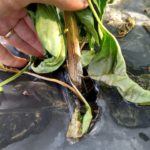
Southern blight of pepper and tomato thrives under hot, dry conditions. Usually, such conditions are more likely in August. Production under tunnels may contribute to the dry conditions that influences southern blight. This article will discuss the symptoms, biology and management of southern blight of tomato. Southern blight has a wide host range affecting many vegetable,…Read more about Southern Blight of Pepper and Tomato[Read More]