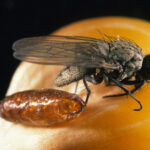
The seedcorn maggot, Delia platura, is one of the first pests that will cause damage to vegetables in the spring in our region. This fly, which resembles a house fly but is smaller (Figure 1), begins to emerge from the overwintering pupal stage in the soil in early spring. Upon emergence, the flies quickly aggregate…Read more about Insect Spotlight: Seedcorn Maggot[Read More]
Insect and Mite Management
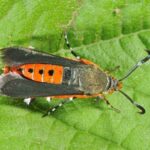
There are many traps available to help with monitoring insect populations. As you prepare for the 2024 growing season, I wanted to review some of them in case you want to implement trapping on your farm to help improve your pest management programs. Trap Design Traps come in a variety of shapes, sizes, and colors….Read more about Insect Traps as a Monitoring Tool[Read More]
If you work or have worked with specialty crops, we are reaching out for your help. To develop a scouting protocol for twospotted spider mite management, we are aiming to identify the limit of detection of this pest by growers. We are hoping that you will take 5-10 minutes to complete a survey displaying a…Read more about Mite Insect Survey[Read More]

The warm weather of late did not only pull us out of our winter slumber but definitely awoke some of our overwintering pests as well. Cucumber beetles and seedcorn maggots are likely on the hunt for food, and your early-season crops may be exactly what they are looking for. Striped cucumber beetles (Figure 1) are…Read more about Threats to Early Seedlings[Read More]
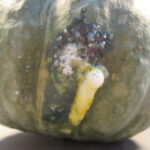
For a few years, I participated in the Squash Hunger Trial led by Dr. Annette Wszelaki, where we grew a wide range of winter squashes at multiple states. One year, I failed to manage insects, leading to a squash bug and cucumber beetle outbreak. The insects defoliated leaves (Figure 1) and caused cosmetic damage to…Read more about What Happened to the Winter Squash?[Read More]
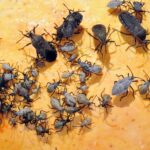
Squash bugs and cucumber beetles (both spotted and striped) are in full swing this time of year on your cucurbit crops. We no longer have to worry about flowers developing into harvestable fruits, so it is a time that you need to think strategically about insect pest damage thresholds in relation to the decision to…Read more about Late Season Pest Management in Pumpkins[Read More]
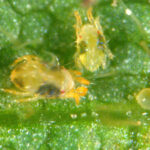
Two-spotted spider mites (TSSM) are one of the most common mite pests occurring throughout the world. They are known to feed on over 300 plant species, including tomatoes, cucumbers, melons, grapes, apples, and a variety of common flower and weed species. They disperse by walking or floating on the wind currents. Early infestations can be…Read more about Mite Management[Read More]
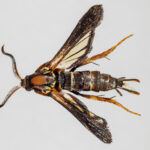
This is my second year coordinating a bucket trap network to monitor squash vine borers. And, for a second year in a row we are witnessing some interesting organisms in the trap. The first of which is the unfortunate capture of pollinators. This is nearly unavoidable because of the color attraction; yellow mimics flowers, but…Read more about Squash Vine Borer (SVB) Trapping Bycatch[Read More]
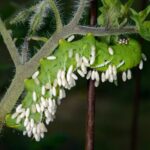
The tobacco hornworm is one of the most devastating tomato pests in Indiana, if left unchecked. There are several natural enemies that help suppress this pest, such as stilt bugs (Figure 1), spined soldier bugs (Figure 2) and the parasitoid Cotesia congregata (Figure 3). Often, these natural enemies are not abundant until later in the…Read more about The Hornworms are Here![Read More]
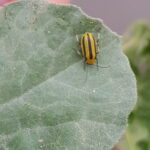
This time of year, when we are busy in the fields planting and prepping for a fruitful season, we need to be observant of the pest pressures that may be present. We have already had reports this year of cucumber beetles feeding on recently transplanted cucurbit crops, in particular melons and cucumbers. Let’s review why…Read more about Early Cucumber Beetle Management[Read More]