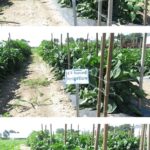
At Pinney Purdue (PPAC) bell peppers were harvested for the first time on August 15. Plants appear a little larger in the irrigated plots than in the unirrigated plots, but it is not obvious in photographs (Figure 1). Similar to what was observed at SWPAC, blossom end rot (BER) was much more common in the…Read more about Irrigation Demonstration Update July Aug. 24, 2022, Pinney Purdue Ag Center.[Read More]
Found 1707 Articles
The Aug. topic of Strawberry Chat is about plasticulture strawberry production. Our special guests were Brad Bergefurd, former Horticulture Specialist at The Ohio State University, Calvin Beasley from Beasley Orchard in Danville, IN, and Danny Vanmeter from Vanmeter Family Farm in Clarkston, KY. We discussed many important topics in plasticulture strawberry production, including site selection,…Read more about Strawberry Chat Plasticulture Production[Read More]
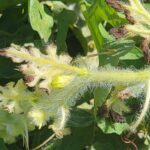
Throughout the growing season, vegetable crop farmers often report suspected herbicide drift injury. Each type of herbicide results in specific types of injury. Knowing what to look for can help us narrow which herbicide or herbicide mode of action could be responsible. To document how watermelon and pumpkin respond to various herbicides, we sprayed a…Read more about Pumpkin and Watermelon Herbicide Injury Symptoms – In Photos[Read More]

Recently, I have observed several pumpkin vines and fruit with Plectosporium blight. When I receive phone calls about Plectosporium blight, the caller often has trouble describing the disease. Indeed, the disease is difficult to describe. Therefore, I will include several photos with this article. Lesions of Plectosporium blight are most often observed on the stems…Read more about Plectosporium Blight of Pumpkin[Read More]
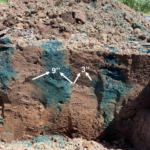
A major difference between drip irrigation and other irrigation methods is that drip irrigation applies water to only a portion of the soil. This works great for vegetables grown on the plastic mulch, since no irrigation water is applied between the row middles; water applied to row middles encourages weed growth. So, does the soil…Read more about Understanding Wetting Patterns in Drip Irrigation[Read More]
Midwest Mechanical Weed Control Field Day will held Wednesday, September 14, 2022 at MSU Southwest Michigan Research and Extension Center in Benton Harbor, MI. Registration and more information about the field day can be found at https://thelandconnection.org/event/2022-mmwcfd/ If you have questions about the field day, please contact Sam Oschwald Tilton (Sam.oschwaldtilton@wisc.edu), phone (608) 219-7775

The Indiana, Ohio, and Michigan Tri-state Community Supported Agriculture (CSA) conference is Saturday and Sunday, November 12th and 13th, in Ft, Wayne, IN. The conference starts with a Hawkins Family Farm tour on Saturday morning. Experts with Central State University, The Ohio State University College of Food, Agricultural, and Environmental Sciences (CFAES), in collaboration with…Read more about Tri-state (Indiana, Ohio, Michigan) Community Supported Agriculture (CSA) Conference in Nov. in Ft. Wayne[Read More]

At Pinney Purdue (PPAC) 2.67 inches of rain fell July 27 through August 9. The potential evapotranspiration (PET) over the period was 1.68 inches. Estimates for water use by the crops are equal to or just slightly lower than potential evapotranspiration. For tomatoes, estimated water use was 1.68 inches, and for watermelons, 1.52 inches. There…Read more about Irrigation Demonstration Update Aug 9, 2022, Pinney Purdue Ag Center[Read More]
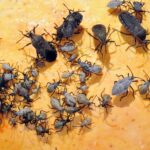
Squash bugs and cucumber beetles (both spotted and striped) are in full swing this time of year on your cucurbit crops. We no longer have to worry about flowers developing into harvestable fruits, so it is a time that you need to think strategically about insect pest damage thresholds in relation to the decision to…Read more about Late Season Pest Management in Pumpkins[Read More]
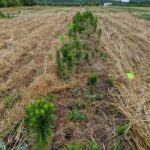
Attendees at a July field day at the Meigs Horticulture Research Farm in Lafayette, Indiana saw first-hand the potential of cover crops to suppress weeds in a SARE-funded demonstration plot. First, some background: Three cover crop species were sown with a ten-foot drill on September 10, 2021: Oats at 100 lb/acre Cereal rye at 65…Read more about Cover Crop Demonstration Plots Show Weed Suppression Potential[Read More]
Purdue University prohibits discrimination against any member of the University community on the basis of race, religion, color, sex, age, national origin or ancestry, genetic information, marital status, parental status, sexual orientation, gender identity and expression, disability, or status as a veteran. This material may be available in alternative formats. 1-888-EXT-INFO Disclaimer: Reference to products in this publication is not intended to be an endorsement to the exclusion of others which may have similar uses. Any person using products listed in this publication assumes full responsibility for their use in accordance with current directions of the manufacturer.