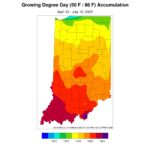
The June 2022 state average precipitation was 2.42 inches below the 1991-2020 normal, which ended up being the 14th driest on record. High heat and reduced precipitation led to the rapid intensification of abnormally dry and moderate drought conditions in the state. As of July 13, July precipitation had continued to be very isolated (Figure…Read more about Isolated Heavy Rainfall, but Drying Continues[Read More]
Found 1707 Articles
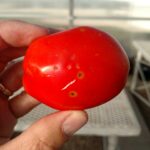
The following is an article in one of a series about bacterial diseases of tomato. Previously, articles about bacterial canker and bacterial spot have been featured here. The next article will be about general management methods for bacterial diseases of tomato. Bacterial speck causes lesions on all above ground portions of the tomato, in a…Read more about Bacterial Speck of Tomato[Read More]

We observed a large amount of unmarketable pepper fruit hanging on the plants during on-farm visits and at the research farms recently. Damage appears on the sides or at the bottom of the fruit (Figure 1). The symptoms that occur at the fruit bottom are similar to tomato blossom end rot (BER), a plant physiological…Read more about Unmarketable Bell Peppers[Read More]
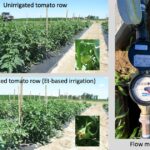
At Pinney Purdue (PPAC) 1.66 inches of rain fell June 25 through July 11. The potential evapotranspiration (PET) over the period was 2.79 inches. Estimates for water use by the crops are lower than potential evapotranspiration because it is only 5 weeks after transplanting. For tomatoes, estimated water use was 2.01 inches, and for watermelons,…Read more about Irrigation Demonstration Update — PPAC July 11[Read More]
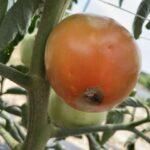
After planting on May 16, we only received 1.4 inches of rain in June. The early-setting tomatoes on plants grown on the unirrigated bed had more than 40% fruit blossom end rot (BER) (recorded on June 23). It was 3% on plants grown in a bed that received 17 irrigation events in June and 10%…Read more about Irrigation Demonstration Update — SWPAC July 13[Read More]

The annual Purdue Small Farm Education Field Day will be presented on July 29th from 9 am – 12 pm at the Purdue Student Farm, West Lafayette. Register the event https://purdue.ca1.qualtrics.com/jfe/form/SV_25gK2j29sF7Is9o If you have any questions about this event, please contact Petrus Langenhoven at (765) 496-7955, plangenh@purdue.edu or Lori Jolly-Brown (765) 494-1296, ljollybr@purdue.edu.

Purdue Fruit, Veg & Hemp Field Day will be held at Meigs Purdue Ag Center (9101 S 100 E, Lafayette, IN 47909) on July 21, 2022. Register the event https://tinyurl.com/ypfubpkp If you have any questions about this event, please contact Petrus Langenhoven at (765) 496-7955, plangenh@purdue.edu or Lori Jolly-Brown (765) 494-1296, ljollybr@purdue.edu.
The Pinney Purdue Vegetable Field Day/Twilight Meeting will be held August 9, 2022, 5 to 8 p.m. Central time (6 to 9 p.m. Eastern time) at 11402 S. County Line Road, Wanatah, IN. The evening program will feature plot tours for farmers and for homeowners featuring topics of irrigation, sweet corn, pumpkins, dry beans, equipment,…Read more about Pinney Purdue Field Day Aug. 9, 2022 – Registration Open[Read More]
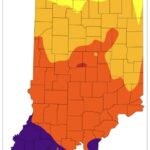
The most recent U.S. Drought Monitor now has over 87 percent of Indiana in some level of dryness and/or drought (Figure 1). The rate this coverage has both expanded and intensified is impressive. Since at least 2012, drought specialists and climatologists have been studying “flash drought” including how to define it and therefore identify it….Read more about Is Indiana Experiencing a Flash Drought?[Read More]

Fruit set of seedless watermelons is reliant on growth hormones released by pollen tube growth and fertilization, the same as seeded watermelons. Pollen from the seedless plants, however, is not viable, thus it is crucial to have viable pollen from seeded cultivars transfer to the female flowers of the seedless plants. The plants that contribute…Read more about Pollenizer Cultivar Observation for Seedless Watermelon Production[Read More]
Purdue University prohibits discrimination against any member of the University community on the basis of race, religion, color, sex, age, national origin or ancestry, genetic information, marital status, parental status, sexual orientation, gender identity and expression, disability, or status as a veteran. This material may be available in alternative formats. 1-888-EXT-INFO Disclaimer: Reference to products in this publication is not intended to be an endorsement to the exclusion of others which may have similar uses. Any person using products listed in this publication assumes full responsibility for their use in accordance with current directions of the manufacturer.