Vegetable growers in Northwest Indiana may want to take advantage of a March 17 Specialty Crop Irrigation Meeting in Benton Harbor, Michigan. Presenters Phil Ausra, Trickl-Eez Irrigation Inc., Dr. Younsuk Dong, MSU Department of Biosystems and Agricultural Engineering Irrigation, and Lyndon Kelley, MSU Extension/Purdue Extension Irrigation Educator will cover irrigation scheduling, irrigation design process, and…Read more about Specialty Crop Irrigation Meeting[Read More]
Liz Maynard

Clinical Engagement Assistant Professor of Horticulture
Department of Horticulture and Landscape Architecture
Liz Maynard's website
Department of Horticulture and Landscape Architecture
Liz Maynard's website
Purdue Extension is planning educational sessions for the Illiana Vegetable Growers Symposium (Jan. 7, 2020 in Schererville), Indiana Horticultural Conference (Feb. 11-13, 2020, in Indianapolis), and others. Your suggestions for topics and speakers that will be useful for your operation help us plan the programs. Phone (219) 548-3674, email emaynard@purdue.edu or text (219) 508-1644 your…Read more about Planning for Educational Programs is Underway: What do You Want to Hear?[Read More]
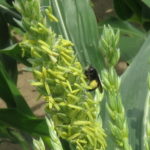
The sweet corn variety plots at Pinney Purdue provide a good chance to observe sweet corn insects. In late July I observed two caterpillars that surprised me. The first was European Corn Borer (ECB), in the tassel where they are often found (Figures 1 & 2). It was a surprise because I have seen many…Read more about Sweet Corn Insect Observations[Read More]
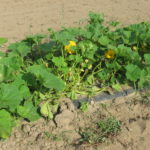
Winter squash – butternut, acorn, and kabocha – in our downy mildew sentinel plot at Pinney Purdue were showing some wilted and stunted plants by late July (Figure 1). They are easily pulled up, the stem breaking off at ground level, revealing a brown stringy decayed-looking stem base (Figure 2). Sometimes there is a little…Read more about Wilting Cucurbits! What could it be?[Read More]

The wet spring has likely delayed some planting of pumpkins. What does delayed planting mean for yield? Data and observations from Purdue Ag Centers offer some perspective to supplement other experience. Figure 1 shows how pumpkin yield was affected by planting date for 6 trials. Each line represents a different trial. The Y-axis shows relative…Read more about Considerations with Delayed Pumpkin Planting[Read More]
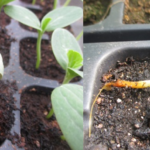
Producing healthy transplants is a critical step for a successful growing season. Choosing the proper growing media is an important first step. Supported by a USDA Specialty Crops Block Grant through the Indiana State Department of Agriculture, researchers from Purdue have been evaluating different organic growing media with and without adding supplemental organic fertilizers for…Read more about Abnormal Transplant Symptoms Might be Caused by Poor Media[Read More]

Dual Magnum® has had a special local needs (24C) label in Indiana for use on transplanted bell peppers and other vegetables for a number of years. Last week the label was amended to include additional small fruit and vegetable crops, including asparagus. The new 24C label is available on the National Pesticide Information Retrieval System…Read more about Dual Magnum Indiana 24C Label Amended to Include More Crops[Read More]
Bolting of crops overwintered in high tunnels is common in the spring. ‘Bolting’ refers to lengthening and blooming of the flowering stalk. Bolting is often a problem because the quality of the marketable part of the plant declines. Also, plants subject to bolting are programmed to die once they complete flowering and seed production so…Read more about Bolting and Blooming in High Tunnels[Read More]
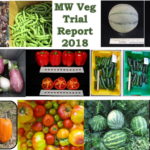
Looking for information about new crop varieties? Reports on variety performance of sweet corn, pumpkin, summer squash and zucchini, melon, watermelon, picking cucumber, pepper, tomato, heritage beans, and specialty eggplant are available online at https://ag.purdue.edu/hla/fruitveg/Pages/mvtr2018.aspx.
Presentations from many past Purdue educational programs for vegetable growers are available online at https://ag.purdue.edu/hla/fruitveg/Pages/presentations.aspx. Slides from the 2019 Illiana Vegetable Growers Symposium are available now. Indiana Hort Congress presentations will be available soon.