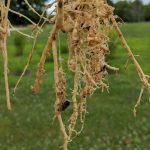
On a sandy hillside in a watermelon field, we noted vines that, from a distance, appeared undersized compared to the vines in the flats. Upon closer inspection, some of the vines had either wilted or a portion of the plant had wilted. The wilted vines had discolored vascular tissue. These vines were affected by Fusarium…Read more about Root-knot Nematode of Watermelon[Read More]
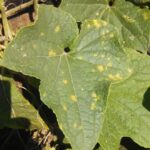
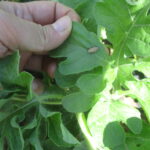
Downy mildew has been observed on cucumber in Berrien County in extreme southwestern Michigan and in Monroe County in extreme southeast Michigan. The downy mildew spores that cause disease on cucumber will cause disease on cantaloupe and may cause disease on other cucurbits such as pumpkin and watermelon. The forecast is for the spread of…Read more about Downy Mildew in Southern Michigan[Read More]
If they have not already, your early season residual herbicides will soon run out of steam. Depending on the crop and production system, you may soon lose the ability to cultivate row middles. Now what? For many vegetable crops, managing emerged weeds is difficult with few postemergence herbicide options. This article will focus on cucurbit…Read more about Considerations for Mid-Season Weed Control in Cucurbits[Read More]
Scientific name: Chenopodium album Common lambsquarters is originally from Eurasia. It is an aggressive weed, adapted to grow vigorously in many different climates and soils, and has been able to establish worldwide. In North America it was once grown as a vegetable crop. In Asia and Africa, it is still cultivated to use as a…Read more about Common Lambsquarters[Read More]
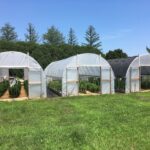
On hot days in the summer, high tunnel growers may wonder whether to place shadecloth on high tunnels. Considering excessive heat inside the structures that may lead to plant stress, blossom drop and unmarketable fruit, there is a rational for doing it. However, it is important to realize the limitations of placing shadecloth on high…Read more about Using Shadecloth on High Tunnels for Tomato and Colored Bell Pepper Production[Read More]
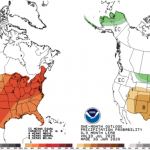
The roller coaster ride of Indiana weather continues. Things were drying out across the state with signs of browning lawns, rolling vegetation leaves, and lowering pond and stream levels. Then the rains came. Most of the state received between 2 and 3 inches of precipitation from June 20 through 29th – with wetter areas to…Read more about Outlooks Showing Confidence for Below-normal Precipitation[Read More]

WHAT: An Indiana Pesticide Clean Sweep Project designed to collect and dispose of suspended, canceled, banned, unusable, opened, unopened or just unwanted pesticides (weed killers, insecticides, rodenticides, fungicides, miticides, etc.) is being sponsored by the Office of Indiana State Chemist (OISC). This disposal service is free of charge up to 250 pounds per participant. Over…Read more about Clean Sweep 2020 – Free Opportunity to Dispose Unwanted Pesticides[Read More]
Hoosier Food Market, an online sales platform where farmers can sell directly to consumers with no overhead costs. COVID-19 has changed the way we do a lot of things. Purdue Agriculture recognized that many farmers markets may not be operating at the same capacity, and restaurants may not be purchasing the same amount of product…Read more about Online Sales Platform – Hoosier Food Market[Read More]

During an OFRR, produce safety experts from ISDH, ISDA, and Purdue Extension will visit produce farms in the state to assess readiness for a FSMA inspection. These reviews are free, voluntary, and confidential. An OFRR takes approximately 2 hours, and it is scheduled at a time that is convenient for the grower. The reviewers will…Read more about On-Farm Readiness Reviews (OFRR), a Free Resource to Indiana Produce Growers[Read More]
Purdue University prohibits discrimination against any member of the University community on the basis of race, religion, color, sex, age, national origin or ancestry, genetic information, marital status, parental status, sexual orientation, gender identity and expression, disability, or status as a veteran. This material may be available in alternative formats. 1-888-EXT-INFO Disclaimer: Reference to products in this publication is not intended to be an endorsement to the exclusion of others which may have similar uses. Any person using products listed in this publication assumes full responsibility for their use in accordance with current directions of the manufacturer.