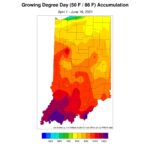
The news of the disastrous drought and extreme heat in the western United States (US) have local folks wondering if Indiana might be next. The latest release of the US Drought Monitor map (Figure 1) shows the exceptional drought in the western states as well as the expansion of extreme and exceptional drought in the…Read more about How Likely will Drought Develop or Worsen in Indiana?[Read More]
Found 1716 Articles
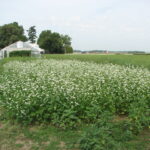
As spring crops finish up, areas where no crop is planned for a month or more are good candidates for a summer cover crop. A number of species reliably establish well in the summer. The best one for a particular situation will depend on the length of time available, the desired benefits, and the following…Read more about Summer Cover Crops for Vegetables[Read More]
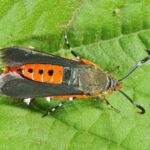
For some, we may often forget about the pesky squash vine borer until it’s too late. This pest of cucurbit crops tends to be sporadic in our region; you are either battling it every year or it hardly makes an appearance. And, unfortunately, our urban farmers tend to get hammered. While it is not so…Read more about Time to Scout for Squash Vine Borer (SVB)[Read More]
The additional aid will fill gaps in previous rounds of assistance and help beginning, socially disadvantaged and small and medium-sized producers that need support. The program includes $700 million for pandemic response and safety grants for PPE and other protective measures to help specialty crop growers, among others; and up to $20 million for additional…Read more about USDA Announces Additional Aid to Ag Producers and Businesses in Pandemic Assistance[Read More]
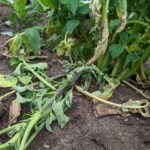
This disease can cause loses by the wilt and decline of plants. This article describes the symptoms and management of two similar diseases of potato both known as black leg caused by different bacterial pathogens. Both black leg diseases have similar symptoms. Often the first symptom one might observe is reduction in plant emergence. After…Read more about Black leg of Potato[Read More]
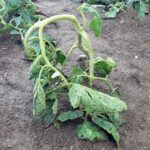
Off-target herbicide movement, whether from on-farm or neighboring farms, is not a new problem. However, in recent years it has been on the top of more minds. Although many crops seem to recover from an off-target herbicide event, vegetative recovery does not always imply that all is well. To illustrate this point, let’s look at…Read more about Herbicide Drift on Tomatoes[Read More]
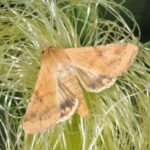
We have begun our state-wide trapping and monitoring program for corn earworm (Figure 1). The latest trap catch information can be found here. Traps have been placed at seven Purdue Agricultural Centers throughout the state. Trapping will begin June 17, 2021. Please refer to E-31 to learn more about corn earworm identification and management. Management…Read more about Corn Earworm Trapping for the 2021 Season is Beginning[Read More]
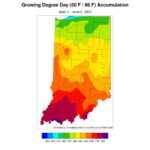
The month of May in Indiana was 2°F-4°F below normal across the state, based upon the new 1991-2020 climatological normals that were released last month. Climatological normals are roughly the 30-year average of weather variables and are updated every 10 years. Prior to the new normals being released, climatologists were using the 1981-2010 period for…Read more about Updated Climate Normals Led to a Cooler May[Read More]
Many years ago, I was told that to successfully use fungicides on vegetables, one must use high spray pressures and hollow cone nozzles. However, I had trouble finding any research on this topic, just rumors. So, I did my own research. Dennis Nowaskie, Superintendent at the Southwest Purdue Agricultural Center (SWPAC) built a single row…Read more about Spray Pressure, Nozzle Type and Vegetable Disease[Read More]

Please join us for the Southwest Purdue Ag Center virtual field day! You will learn about many exciting research projects conducted at the research center. Topics on horticultural crops include: – Rainfastness of fungicides – What can IPM adoption in watermelons mean for pests, pollinators and profit? – Strawberry production with alternative systems – High…Read more about Southwest Purdue Ag Center Virtual Field Day[Read More]
Purdue University prohibits discrimination against any member of the University community on the basis of race, religion, color, sex, age, national origin or ancestry, genetic information, marital status, parental status, sexual orientation, gender identity and expression, disability, or status as a veteran. This material may be available in alternative formats. 1-888-EXT-INFO Disclaimer: Reference to products in this publication is not intended to be an endorsement to the exclusion of others which may have similar uses. Any person using products listed in this publication assumes full responsibility for their use in accordance with current directions of the manufacturer.