Striped cucumber beetles are emerging from their overwintering habitat in southern Indiana. This pest can damage cucurbit crops in several ways. One that I saw this week is that they can kill young transplants by their direct feeding. Of more critical concern usually is their ability to transmit the bacterium that causes bacterial wilt of…Read more about Striped Cucumber Beetles[Read More]
Cucurbits
It’s early in the growing season, but I am already receiving calls about aphids on melons. We had lots of problems with aphids in 2013 and not very many last year. Particularly at this time of year, I’m recommending Assail® for aphid control on melons for several reasons. First, it does an excellent job killing…Read more about Aphids on Melons[Read More]
I have received calls about seedcorn maggots in melons and have seen wireworm damage in my research plots in Vincennes. Seedcorn maggots are usually associated with cool weather since the adult flies will not lay their eggs near melons plants when the soil temperature exceeds 70°F. So the cool weather we have had this past…Read more about Seedcorn Maggots and Wireworms[Read More]
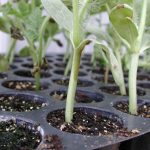
Most watermelon growers are in the process of placing transplants in the field. I have received several commercial samples of transplants still in trays prior to out-planting. The two diseases I have observed so far are gummy stem blight and bacterial fruit blotch. Below, I discuss these two diseases as well as management options. Gummy stem blight on…Read more about Watermelon Disease Update[Read More]
Many cantaloupe and watermelon growers have planted transplants in the field or will soon. A question many growers often have is when and how should one apply fungicides. Applying fungicides according to a weather-based system is easy for cantaloupe and watermelon growers. MELCAST was developed at Purdue University by Rick Latin to allow growers to…Read more about MELCAST[Read More]
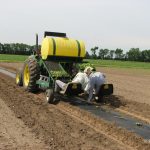
Getting seedlings from the transplant tray into the field is essential for a good crop (Figure 1). Healthy transplants treated well will quickly establish themselves in the field, setting the foundation for a productive crop. Here I offer some suggestions for successful transplant establishment. Harden transplants by exposing them to higher light, cooler temperature, and…Read more about Successful Transplant Establishment[Read More]
The cool, wet weather we have been having is perfect for the root and seed maggots in early planted vegetables. I have already received calls about onion maggots. If you are planting early vegetables, check out the article in the March 17, 2015, issue of the Hotline for 2015. So, how do we define early…Read more about Root and Seed Maggots[Read More]
For most insect pests, we have some viable options to manage them organically. For years we have been looking for an organic solution for striped cucumber beetle and bacterial wilt on melons and cucumbers. It appears that we now have a viable option. There is a relatively new product, Cidetrak D, manufactured by Trece, which…Read more about Organic Control of Striped Cucumber Beetles[Read More]
As you all know, many of our vegetable crops are dependent upon pollinators to move pollen from flower to flower. The cucurbits, muskmelons, cucumbers, watermelons, pumpkins, and squash, are completely dependent on insect pollination. Eggplant, okra, lima beans, and peppers will set fruit without pollinators but can have increased yield if pollinators are present. Honey…Read more about Honey Bees and Other Pollinators[Read More]
In December 2014, I described the ‘Yearbook of Agriculture, 1928”. In that blog, I wrote about processing tomato production in 1925 and 2013 (the ‘Yearbook of Agriculture, 1928’ lists data back to 1925). Today, I would like to discuss cantaloupe and watermelon production. Unfortunately, yields posted in the “Yearbook” are in different units than in…Read more about Cucurbit Production in Indiana: 1925 and 2013[Read More]
Read more about Cucurbit Production in Indiana: 1925 and 2013