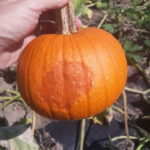
Pumpkin and winter squash should be harvested fully mature to reach their optimal quality and fulfill their potential shelf life. Characters indicating fruit maturity include loss of rind surface gloss, ground spot yellowing, and hardening of the skin to the level that it is resistant to puncture with a thumbnail. Except for some striped varieties,…Read more about Tips for Harvest and Postharvest of Pumpkin and Winter Squash[Read More]
Cucurbits
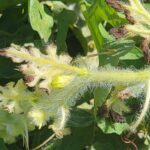
Throughout the growing season, vegetable crop farmers often report suspected herbicide drift injury. Each type of herbicide results in specific types of injury. Knowing what to look for can help us narrow which herbicide or herbicide mode of action could be responsible. To document how watermelon and pumpkin respond to various herbicides, we sprayed a…Read more about Pumpkin and Watermelon Herbicide Injury Symptoms – In Photos[Read More]

Recently, I have observed several pumpkin vines and fruit with Plectosporium blight. When I receive phone calls about Plectosporium blight, the caller often has trouble describing the disease. Indeed, the disease is difficult to describe. Therefore, I will include several photos with this article. Lesions of Plectosporium blight are most often observed on the stems…Read more about Plectosporium Blight of Pumpkin[Read More]
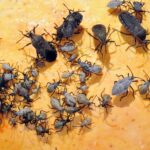
Squash bugs and cucumber beetles (both spotted and striped) are in full swing this time of year on your cucurbit crops. We no longer have to worry about flowers developing into harvestable fruits, so it is a time that you need to think strategically about insect pest damage thresholds in relation to the decision to…Read more about Late Season Pest Management in Pumpkins[Read More]
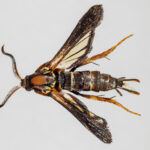
This is my second year coordinating a bucket trap network to monitor squash vine borers. And, for a second year in a row we are witnessing some interesting organisms in the trap. The first of which is the unfortunate capture of pollinators. This is nearly unavoidable because of the color attraction; yellow mimics flowers, but…Read more about Squash Vine Borer (SVB) Trapping Bycatch[Read More]
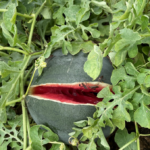
We received more than 8 inches of rain since the evening of July 24 at Southwest Purdue Ag Center. This article discusses a few plant physiological disorders we observed after the heavy rains. We noticed a large percentage of cracked fruit on tomatoes at the stem end (Figure 1). Fruit cracking is a physiological disorder…Read more about Physiological Disorders after Heavy Rains[Read More]
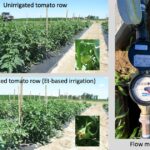
At Pinney Purdue (PPAC) 1.66 inches of rain fell June 25 through July 11. The potential evapotranspiration (PET) over the period was 2.79 inches. Estimates for water use by the crops are lower than potential evapotranspiration because it is only 5 weeks after transplanting. For tomatoes, estimated water use was 2.01 inches, and for watermelons,…Read more about Irrigation Demonstration Update — PPAC July 11[Read More]
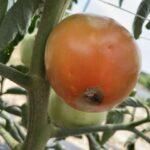
After planting on May 16, we only received 1.4 inches of rain in June. The early-setting tomatoes on plants grown on the unirrigated bed had more than 40% fruit blossom end rot (BER) (recorded on June 23). It was 3% on plants grown in a bed that received 17 irrigation events in June and 10%…Read more about Irrigation Demonstration Update — SWPAC July 13[Read More]

Fruit set of seedless watermelons is reliant on growth hormones released by pollen tube growth and fertilization, the same as seeded watermelons. Pollen from the seedless plants, however, is not viable, thus it is crucial to have viable pollen from seeded cultivars transfer to the female flowers of the seedless plants. The plants that contribute…Read more about Pollenizer Cultivar Observation for Seedless Watermelon Production[Read More]
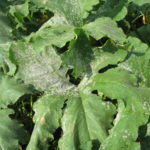
Powdery mildew is a common disease of cucurbits in Indiana. This disease is more common on cantaloupe and pumpkin. However, we have observed powdery mildew more frequently on watermelon in recent years. We have also observed this disease on cucumber in high tunnels. If left uncontrolled, this disease can cause loss of foliage, loss of…Read more about Powdery Mildew-Biology[Read More]