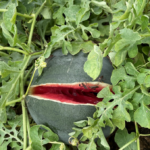
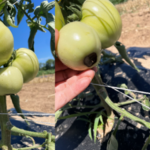
We received more than 8 inches of rain since the evening of July 24 at Southwest Purdue Ag Center. This article discusses a few plant physiological disorders we observed after the heavy rains. We noticed a large percentage of cracked fruit on tomatoes at the stem end (Figure 1). Fruit cracking is a physiological disorder…Read more about Physiological Disorders after Heavy Rains[Read More]
Cucurbits
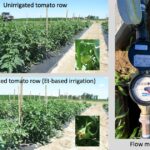
At Pinney Purdue (PPAC) 1.66 inches of rain fell June 25 through July 11. The potential evapotranspiration (PET) over the period was 2.79 inches. Estimates for water use by the crops are lower than potential evapotranspiration because it is only 5 weeks after transplanting. For tomatoes, estimated water use was 2.01 inches, and for watermelons,…Read more about Irrigation Demonstration Update — PPAC July 11[Read More]
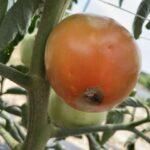
After planting on May 16, we only received 1.4 inches of rain in June. The early-setting tomatoes on plants grown on the unirrigated bed had more than 40% fruit blossom end rot (BER) (recorded on June 23). It was 3% on plants grown in a bed that received 17 irrigation events in June and 10%…Read more about Irrigation Demonstration Update — SWPAC July 13[Read More]

Fruit set of seedless watermelons is reliant on growth hormones released by pollen tube growth and fertilization, the same as seeded watermelons. Pollen from the seedless plants, however, is not viable, thus it is crucial to have viable pollen from seeded cultivars transfer to the female flowers of the seedless plants. The plants that contribute…Read more about Pollenizer Cultivar Observation for Seedless Watermelon Production[Read More]
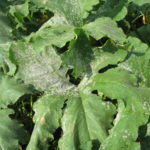
Powdery mildew is a common disease of cucurbits in Indiana. This disease is more common on cantaloupe and pumpkin. However, we have observed powdery mildew more frequently on watermelon in recent years. We have also observed this disease on cucumber in high tunnels. If left uncontrolled, this disease can cause loss of foliage, loss of…Read more about Powdery Mildew-Biology[Read More]
The following article was written by a colleague located on Long Island in New York. She is an expert on cucurbit powdery mildew. The fungicides which are effective against cucurbit powdery mildew changes frequently as fungi become resistant to certain fungicides. While the situation Dr. McGrath describes may not match your field exactly, it makes…Read more about Conventional Fungicide Recommendations for Cucurbit Powdery Mildew[Read More]
At Southwest Purdue Ag Center (SWPAC) and Pinney Purdue Ag Center (PPAC), we demonstrate irrigation impacts on several fruiting vegetable crops. Tomato, pepper, eggplant, watermelon, and cantaloupe are planted on plastic-covered beds with drip tapes. They grow on beds side-by-side with and without irrigation. We used two approaches to schedule irrigation, one bed is irrigated based on…Read more about Irrigation Demonstration Update June 25[Read More]

Thanks to my University of California Cooperative Extension colleagues, I visited central valley vegetable production last week. Undoubtedly, I learned a lot on this trip. I want to share what I learned with Indiana growers in a few newsletter articles. This short article highlights two things I saw farmers use to extend early-season crop production….Read more about Season Extension Strategies—What I learned in a CA trip[Read More]
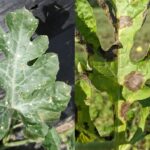
The following is a brief report of the pest and non-infectious problems found on vegetable in Indiana over the past 10 days. Tomato-In high tunnels and greenhouses, scattered growers have observed leaf mold, gray mold and white mold. Tomato spotted wilt has also been observed on tomatoes in high tunnels. Unfortunately, herbicide drift has also…Read more about Scouting Report[Read More]
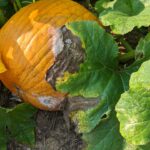
In the next month, many growers will start to plant pumpkins. This article will introduce aspects of disease management of pumpkins prior to the growing season. The information below is discussed under several of the most common diseases of pumpkins in Indiana. The objective of this article is to discuss what diseases are more likely…Read more about A Brief Primer on Disease Management of Pumpkin[Read More]