Pumpkin planting is right around the corner. The recent Vegetable Beet Podcast produced by Great Lakes Vegetable Producers Network featured Brad Bergefurd from The Ohio State University and Nathan Johanning from University of Illinois talking about Pre-season Pumpkin Tips. They shared many of their insights in planting spacing, fertility management, weed control, no-till etc. A…Read more about Pumpkin Resources[Read More]
Cucurbits
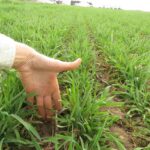
In a recent Hoosier Ag Today/CCSI Soil Health Podcast, Stephen Meyers of Purdue Horticulture and Dan Perkins of Perkins Good Earth Farm covered spring management of cover crops on vegetable farms. They discussed a variety of methods for terminating: flail mowing and tarping, roller-crimping, tillage, and killing with herbicide. They pointed out that decisions about…Read more about Cover Crops in May: Soil Health Podcast on Spring Management and Observations of Winter Rye at Pinney Purdue[Read More]
MELCAST is a weather-based disease-forecasting program that helps growers schedule foliar fungicides applications for watermelon and cantaloupe. MELCAST stands for MELon disease for CASTer. This program, designed by Dr. Rick Latin, Professor of Plant Pathology at Purdue University, keeps track of weather conditions so that cantaloupe and watermelon growers can apply foliar fungicides to their…Read more about MELCAST 2021[Read More]
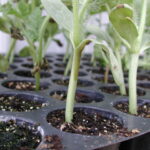
Many cantaloupe and watermelon growers are either growing transplants in a greenhouse or are expecting delivery of transplants in the next few weeks. Either way, growers should inspect transplants for disease before planting in the field. Below I will describe several common transplant diseases of cantaloupe and watermelon as well as management options. Gummy stem…Read more about Cantaloupe and Watermelon Transplant Diseases[Read More]

The average American eats almost 9 pounds of cantaloupe and 2 pounds of honeydew each year (Agricultural Marketing Resource Center, 2018). An increased melon consumption is mainly explained by consumer awareness of melon health benefits, year-round availability, creative marketing strategies, and improved cultivars. To address these economic opportunities, retailers, growers, and other industry stakeholders should…Read more about The Three Types of Melon Consumers[Read More]
At the Pinney Purdue Ag Center in northern Indiana we had plots in 2020 with no-till sweet corn, pumpkins and winter squash following a rye cover crop. As is common when adapting new planting and tillage systems, we had both challenges and successes. Check out the video presentations to see photos of the plots, and…Read more about No-till Sweet Corn, Pumpkin and Winter Squash after Winter Rye – Reports from 2020[Read More]
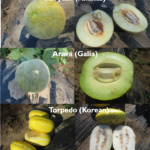
Melon is a crop with diverse fruit characteristics. They have different color, shape, rind pattern, texture, and flavor. In major food stores, cantaloupe and honeydew melons may be the only melon types sold, while the fantastic experience of melon consumption is far more than that. This created an opportunity for selling unique melon fruit at local farmers’ market and with a potentially higher price. It…Read more about Specialty Melon Evaluation in Southern Indiana[Read More]
A new publication High Tunnel Cucumber Production Guide is available and can be downloaded at https://extension.entm.purdue.edu/publications/ID-521/ID-521-W.pdf This cucumber production guide provides resources and recommendations tailored to the distinctive growing environment of high tunnels. Recommendations are based on research efforts conducted in the Midwest U.S. and include cultivar selection, pruning and trellising systems, insect and mite…Read more about High Tunnel Cucumber Production Guide[Read More]
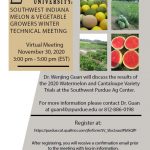
The Annual Fall/Winter Meeting of the Southwest Indiana Melon and Vegetable Growers is scheduled on Monday, November 30, 2020, 3:00 pm – 5:00 pm (EST). This meeting will be held online this year because of COVID-19 restrictions. Dr. Wenjing Guan and Dr. Dan Egel will discuss the results of the 2020 watermelon and cantaloupe variety…Read more about Southwest Indiana Melon and Vegetable Growers Winter Meeting[Read More]
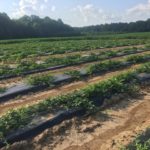
Thanks to growers’ collaboration and help from Superior Ag, we collected plant tissue samples from 12 watermelon fields at different crop growing stages in Southern Indiana in the 2020 season. In a previous article, we discussed results about magnesium and potassium. In this article, we will discuss another nutrient, Sulfur (S). Sulfur deficiency has become…Read more about Survey of Watermelon Nutritional Status in Southern Indiana – Sulfur[Read More]