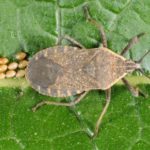
You may be seeing a few “stink bug-like” insects crawling around on your cucurbit crops this time of year. However, these slightly more slender insects are not stink bugs, they are actually squash bugs. Similarly to stink bugs though, they do give off quite an odor when crushed! Squash bug adults and nymphs (immatures) (Figures…Read more about Do You Need to Squash those Bugs on Your Pumpkins?[Read More]
Cucurbits
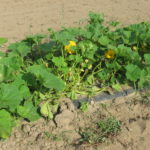
Winter squash – butternut, acorn, and kabocha – in our downy mildew sentinel plot at Pinney Purdue were showing some wilted and stunted plants by late July (Figure 1). They are easily pulled up, the stem breaking off at ground level, revealing a brown stringy decayed-looking stem base (Figure 2). Sometimes there is a little…Read more about Wilting Cucurbits! What could it be?[Read More]

I have observed this disease in scattered commercial pumpkin and squash fields across Indiana. Symptoms: Bacterial spot causes ⅛-¼ inch angular leaf lesions that are white to light brown in color (Figure 1). These leaf lesions may be accompanied by yellowing (chlorosis). The more important symptom are the lesions on fruit that are scabby to…Read more about Bacterial Spot of Pumpkin[Read More]
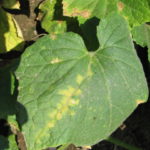
Cucurbit downy mildew has been observed on cucumber in the southwest corner of Michigan, just across the border from La Porte County and LaGrange Counties, Indiana. All cucurbit growers in Indiana should be scouting for downy mildew. Cucurbit growers in northern Indiana should be managing for downy mildew. The organism that causes downy mildew of…Read more about Downy Mildew of Cucurbits in Michigan[Read More]
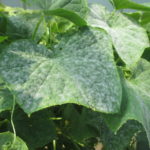
Powdery mildew is particularly severe in high tunnel and greenhouse growing conditions (Figure 1). It affects a wide range of crops including tomatoes and cucumbers. In addition to using synthetic fungicides to control this disease in high tunnels, we found powdery mildew on cucumbers can also be effectively controlled through variety selection and intensive plant…Read more about Variety Selection is Important for Managing Cucumber Powdery Mildew in High Tunnels[Read More]
The 2019 production season started with above-normal rains. The wet conditions affected agriculture production, including watermelon and cantaloupe. In this article, we will review some of the watermelon and cantaloupe problems that are often associated with wet conditions. Manganese toxicity– This nutrient disorder occurs more often on cantaloupe that is grown in soils with pH…Read more about Results of Wet Condition on Watermelon and Cantaloupe[Read More]

The wet spring has likely delayed some planting of pumpkins. What does delayed planting mean for yield? Data and observations from Purdue Ag Centers offer some perspective to supplement other experience. Figure 1 shows how pumpkin yield was affected by planting date for 6 trials. Each line represents a different trial. The Y-axis shows relative…Read more about Considerations with Delayed Pumpkin Planting[Read More]

Supported by NC SARE (LNC17-390), we are continuing research for improving high tunnel cucumber production. One of the biggest challenges for growing cucumbers in high tunnels in the summer is two-spotted spider mites. Dry and hot environments featured in high tunnels allow two-spotted spider mite populations to increase rapidly. The mites cause leaf yellowing, necrosis,…Read more about Watch for Two-spotted Spider Mites on High Tunnel Cucumbers[Read More]

I know this may not come as a surprise to most of you, but it is rare that we get to observe the effectiveness of insecticides in such a dramatic way as we encountered when visiting a melon grower in southern IN recently. And in this case, the decision to apply an insecticide at transplant…Read more about Insecticides Kill Insects[Read More]

Finally the time has come to plant warm season crops. Zucchini is a popular summer squash grown throughout Indiana and the United States. It always delivers a bounty of fruit. Yes, technically zucchini is a fruit (botanically classified as a modified berry) but as per the USDA it is listed under the ‘Vegetables and Vegetable…Read more about Growing a Bountiful Zucchini Crop[Read More]