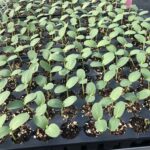
Most of us know a temperature lower than 32°F would kill tender vegetables like tomatoes, peppers, melons, and cucumbers. Home gardeners would wait to plant those crops after the last frost passed, but commercial farmers may take the risk of planting earlier to capture early-season premium prices. Farmers use various strategies, i.e., high tunnels, low…Read more about Check Soil Temperatures Before Planting Cold Sensitive Crops[Read More]
Cucurbits

This article was originally written by Dan Egel, who retired from Purdue. Please contact the PPDL for more information. MELCAST is a weather-based disease-forecasting program that helps growers schedule foliar fungicide applications for cantaloupe and watermelon. MELCAST stands for MELon disease for CASTer. This program, designed by Dr. Rick Latin, Professor Emeritus of Plant Pathology at…Read more about Melon Disease Forecaster 2024[Read More]
We are happy to announce that Purdue Extension is presenting its annual Fruit and Vegetable Field Day on July 20, 2023, at the Throckmorton/Meigs Horticulture Farm, Lafayette, IN. Registration is now open. To register your spot, visit https://cvent.me/5zevYD The field day schedule is very exciting, something for everyone to look forward to. Sweet corn pest…Read more about Purdue Fruit and Vegetable Field Day – Registration Now Open[Read More]
We are excited to announce that the Southwest Purdue Agricultural Center Field Day is scheduled for June 28, 2023, at the Southwest Purdue Agricultural Center (SWPAC), 4669 N. Purdue Rd. Vincennes, IN. Purdue researchers and NRCS representatives will present their current research and demonstration projects in fruit and vegetable production conducted at SWPAC. The topics…Read more about Southwest Purdue Agricultural Center Field Day _Registration Now Open![Read More]
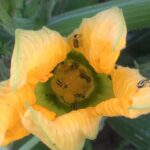
The warm weather of late did not only pull us out of our winter slumber but definitely awoke some of our overwintering pests as well. Cucumber beetles and seedcorn maggots are likely on the hunt for food, and your early-season crops may be exactly what they are looking for. Striped cucumber beetles (Figure 1) are…Read more about Threats to Early Seedlings[Read More]

The 2022 Purdue Small Farm Education Field Day was a big success. Nearly 72% of attendees reported that they learned something new. Nearly half indicated they plan to adopt recommended practices for diversified farming systems, and over a third (36.0%) plan to adopt recommended practices for creating, improving, or strengthening their business. Half (52.0%) indicated…Read more about Small Farm Education Field Day, July 27, 2023[Read More]

Purdue Extension presented its first Fruit, Vegetable and Hemp Field Day post-pandemic at the Meigs Ag Center in July 2022. Extension Specialists and Graduate Students presented specialty crop research to 45 attendees. Attendees had only good things to say about the event. ” Great information and research.” “Great variety of experiences and knowledge.” “I felt…Read more about Purdue Fruit and Vegetable Field Day – July 20, 2023[Read More]

The Midwest Vegetable Trial Report series includes reports of applied research relevant to vegetable and melon production in the midwestern U.S. The purpose of the series is to publish results and document the annual results of vegetable and melon research projects. In 2022, 16 trial reports from Indiana, Illinois, Michigan, and Minnesota were published. Variety…Read more about Midwest Vegetable Trial Reports. A Great Resource for Growers.[Read More]
Purdue Extension presented its first Fruit, Vegetable and Hemp Field Day post-pandemic at the Meigs Ag Center in July 2022. Extension Specialists and Graduate Students presented specialty crop research to 45 attendees. Attendees had only good things to say about the event. ” Great information and research.” “Great variety of experiences and knowledge.” “I felt…Read more about Purdue Fruit and Vegetable Field Day – July 20, 2023[Read More]

The 2022 Purdue Small Farm Education Field Day was a big success. Nearly 72% of attendees reported that they learned something new. Nearly half indicated they plan to adopt recommended practices for diversified farming systems, and over a third (36.0%) plan to adopt recommended practices for creating, improving, or strengthening their business. Half (52.0%) indicated…Read more about Small Farm Education Field Day – July 27, 2023[Read More]