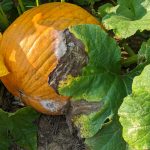
Phytophthora blight was a serious disease this past season. As a result, I have had many questions about managing this disease. The following article is an update of a previous article on this subject. The questions I have been asked have ranged from what do I spray to how does this disease work? Therefore, I…Read more about Phytophthora Blight of Cucurbits[Read More]
Pumpkins
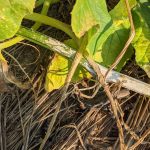
This disease appears to be more important each year. It is not clear to me why. This article reviews Plectosporium of pumpkin, sometimes called white speck. I would rank Plectosporium blight behind powdery mildew, bacterial leaf spot and Phytophthora blight in economic damage caused. The occurrence of this disease is usually sporadic. However, when it…Read more about Plectosporium blight of Pumpkin[Read More]
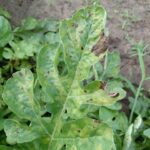
Downy mildew has been observed in LaPorte County in northern Indiana on cucumber. In addition, downy mildew on cucumber has been reported in southern Kentucky and on watermelon in the Kansas City area of Kansas. Growers in northern Indiana should manage for downy mildew on valuable cucurbit crops (Figure 1). Growers throughout the state should…Read more about Cucurbit Downy Mildew[Read More]
No-till pumpkin podcast starts the specialty crops series in the HAT-Soil Health podcasts from CCSI, Purdue and Hoosier Ag Today.
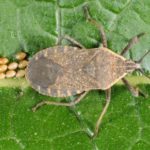
You may be seeing a few “stink bug-like” insects crawling around on your cucurbit crops this time of year. However, these slightly more slender insects are not stink bugs, they are actually squash bugs. Similarly to stink bugs though, they do give off quite an odor when crushed! Squash bug adults and nymphs (immatures) (Figures…Read more about Do You Need to Squash those Bugs on Your Pumpkins?[Read More]
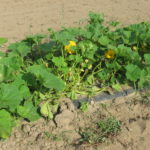
Winter squash – butternut, acorn, and kabocha – in our downy mildew sentinel plot at Pinney Purdue were showing some wilted and stunted plants by late July (Figure 1). They are easily pulled up, the stem breaking off at ground level, revealing a brown stringy decayed-looking stem base (Figure 2). Sometimes there is a little…Read more about Wilting Cucurbits! What could it be?[Read More]
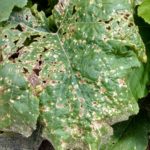
I have observed this disease in scattered commercial pumpkin and squash fields across Indiana. Symptoms: Bacterial spot causes ⅛-¼ inch angular leaf lesions that are white to light brown in color (Figure 1). These leaf lesions may be accompanied by yellowing (chlorosis). The more important symptom are the lesions on fruit that are scabby to…Read more about Bacterial Spot of Pumpkin[Read More]

The wet spring has likely delayed some planting of pumpkins. What does delayed planting mean for yield? Data and observations from Purdue Ag Centers offer some perspective to supplement other experience. Figure 1 shows how pumpkin yield was affected by planting date for 6 trials. Each line represents a different trial. The Y-axis shows relative…Read more about Considerations with Delayed Pumpkin Planting[Read More]

With the start of pumpkin harvest, it is a good time to review important considerations for harvest and postharvest storage of pumpkins and winter squash (butternut, acorn and hubbard squash etc.). Pumpkin and winter squash should be harvested fully mature to reach their optimal quality and fulfill their potential for long shelf lives. Characters indicating…Read more about Harvest and Postharvest Storage of Pumpkins and Winter Squash[Read More]