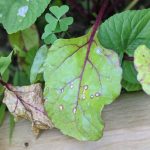
This disease was observed in a home garden recently on table beet (Figure 1). I was surprised considering how dry it has been. Cercospora leaf spot also affects swiss chard. Symptoms include circular leaf spots that may have a reddish margin. The center of the lesions may start off a light brown and turn to gray after the fungus (Cercospora beticola) begins to sporulate….Read more about Cercospora Leaf Spot of Beet[Read More]
Root, Tuber, and Bulb Crops
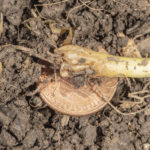
Each and every spring we get reports of poor seed emergence, seedling and transplant damage in early planted crops of all sorts. Most recently in untreated sweet corn, home gardens and transplanted onions. Lucky for us, we got to dive right into this pest and see them in action, but not so lucky for the…Read more about Seedling Damage by Maggot Pests[Read More]
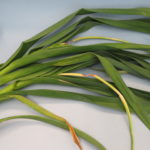
Earlier this summer, sunken lesions were observed on garlic scapes on a small farm in east central Indiana. Lesions started out a cream or tan color (Figure 1), however under rainy or humid conditions, spore production caused lesions to turn orange (Figure 2). Larger lesions resulted in the collapse of the scapes. It is estimated…Read more about Anthracnose of Garlic a New Disease to Indiana[Read More]
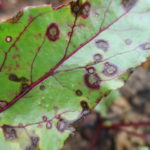
This disease was observed in southern Indiana recently. Cercospora leaf spot affects table beets and swiss chard. Symptoms include circular leaf spots that may have a reddish margin. The center of the lesions may start off a light brown and turn to gray after the fungus (Cercospora beticola) begins to sporulate. Under conditions conducive to…Read more about Cercospora Leaf Spot of Beet[Read More]

Daikon radish is a member of Brassica family. It forms a large white tap root like a giant carrot. The tap root (12 to 20 inches long and 2 to 4 inches in diameter) penetrates into the soil leaving 2 to 6 inches protruding above ground. Radishes are cool-season crops. They are best grown with…Read more about Daikon Radish[Read More]
Read more about Daikon Radish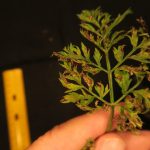
Last fall, my lab received a carrot sample with disease-like lesions (Figures 1 and 2). There are at least 3 carrot diseases that may appear similar. These diseases are: Alternaria leaf blight (late blight), Cercospora leaf spot (early blight) and bacterial leaf blight. Often an examination in the laboratory is necessary. My examination revealed the characteristic spores…Read more about Alternaria Leaf Blight of Carrot[Read More]
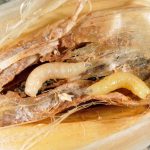
Three species of seed and root maggots attack vegetables in Indiana. The seedcorn maggot (Figure 1) feeds on seeds and seedlings of sweetcorn, cucurbits, lima and snap beans, peas, and other crops. Cabbage maggots can cause serious damage to transplants of cabbage, broccoli, cauliflower, and Brussels sprouts and make the fleshy roots of radishes, turnips,…Read more about Seed and Root Maggots[Read More]
I’ve seen some substantial populations of potato leafhoppers recently. Leafhoppers can be a significant pest of a number of vegetable crops, with potato and snap beans being particularly affected. Look for adults flitting off the plants when they are disturbed and for nymphs feeding on the underside of the leaves. It is important not to…Read more about Potato Leafhopper[Read More]
The cool, wet weather we have been having is perfect for the root and seed maggots in early planted vegetables. I have already received calls about onion maggots. If you are planting early vegetables, check out the article in the March 17, 2015, issue of the Hotline for 2015. So, how do we define early…Read more about Root and Seed Maggots[Read More]
Three species of seed and root maggots attack vegetables in Indiana. The seedcorn maggot feeds on seeds and seedlings of sweet corn, cucurbits, lima and snap beans, peas, and other crops. Cabbage maggots can cause serious damage to transplants of cabbage, broccoli, cauliflower, and Brussels sprouts and make the fleshy roots of radishes, turnips, and…Read more about Seed and Root Maggots[Read More]