
In March 2015 the Department of Horticulture and Landscape Architecture appointed Dr. Petrus Langenhoven as Horticulture and Hydroponics Crop Specialist. During the past 18 years Dr. Petrus Langenhoven has dedicated his career to the development of the horticulture sector in Sub-Saharan Africa. His career started off at the Agricultural Research Council in Stellenbosch, South Africa….Read more about Exciting Future for Horticulture in Indiana[Read More]
Vegetable Crops - General
A field day will be held on July 9 to share with the public the various research activities at the Southwest Purdue Agricultural Center in Vincennes, IN. The day will start at 7:30 A.M. with a health fair. Registration starts at 8:30 A.M. Presentation topics include: managing cucumber beetles while protecting bees, production of vegetables…Read more about Southwest Purdue Agricultural Center Field Day[Read More]
Samples in plug trays, as well as unrooted and rooted cuttings, and plants in pots require extra care when they are packaged for submittal to a diagnostic lab. Before you mail the next sample, please take a few minutes to review these suggestions for packaging and submitting samples. This will help preserve the integrity of…Read more about Tips for Submitting Greenhouse Samples to the Purdue Plant and Pest Diagnostic Lab[Read More]
Purdue University and the Illiana Watermelon Association (IWA) are offering food safety audit cost-share programs to Indiana fruit and vegetable growers this year. Funds for the programs come from a grant from the Indiana State Department of Agriculture through the USDA Specialty Crops Block Grant Program. Through the Purdue program, Indiana fruit or vegetable growers…Read more about Food Safety Audit Cost-share and Consulting Program[Read More]
Some of the herbicides available for use on vegetables in Indiana are registered under a supplemental label or under a special local needs (SLN, 24(c)) registration. In these cases the instructions for use on vegetables are not on the main label that comes with the purchased product. For instance, in the Midwest Vegetable Production Guide,…Read more about Finding a Special Local Needs Pesticide Label Online[Read More]
Since the season of applying fungicides to vegetable crops has arrived, below I have listed 10 rules that will help vegetable growers apply fungicides effectively and safely. Apply fungicides prior to the development of disease. Although many fungicides have systemic (“kick back”) action they will not completely eradicate diseases after they have started. And by…Read more about 10 Useful Rules for Fungicide Applications[Read More]
This time of year, I receive many questions about what fungicides to apply. I get fewer questions about how to apply fungicides. Below, I will try to address how to apply fungicides. Many years ago, I was told that to successfully use fungicides on vegetables, one must use high spray pressures and hollow cone nozzles. However, I had…Read more about Spray Pressure and Nozzle Types[Read More]
As you all know, many of our vegetable crops are dependent upon pollinators to move pollen from flower to flower. The cucurbits, muskmelons, cucumbers, watermelons, pumpkins, and squash, are completely dependent on insect pollination. Eggplant, okra, lima beans, and peppers will set fruit without pollinators but can have increased yield if pollinators are present. Honey…Read more about Honey Bees and Other Pollinators[Read More]
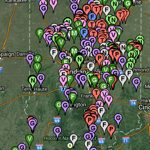
Vegetable, fruit, and organic farmers can register their production areas on Driftwatch.org to let commercial pesticide applicators know where the fields are. Beekeepers can also register sites where beehives are located. Once sites are registered and approved they appear on the Driftwatch registry map (see Fig. 1) and partnering applicators are notified. This helps applicators…Read more about Are Your Fields Listed at Driftwatch.org?[Read More]
Cover crops should be killed at least a couple of weeks before planting vegetables. That will give the cover time to partially decompose, and time for any cutworm larvae that may be in the crop to die or pupate. If wet weather delays killing or incorporation of cover crops, the time between incorporation and planting…Read more about Managing Cover Crops in Spring[Read More]