NW Indiana vegetable farmers may be wondering if they missed information about the Illiana Vegetable Growers Symposium (aka ‘Teibel’s Meeting’) which normally shows up in the mailbox or email just after Thanksgiving. You haven’t missed anything. Instead of the traditional one-day educational program held at Teibel’s Restaurant in early January, Purdue Extension in NW Indiana…Read more about NW Indiana Vegetable Programs[Read More]
Liz Maynard

Clinical Engagement Assistant Professor of Horticulture
Department of Horticulture and Landscape Architecture
Liz Maynard's website
Department of Horticulture and Landscape Architecture
Liz Maynard's website
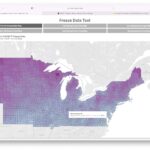
The Midwestern Regional Climate Center recently released a freeze date tool. It makes it easy to find historical temperature information that may help growers plan. This article provides a quick introduction to the tool. Many readers are familiar with the average first fall frost and last spring frost dates, and the frost-free growing season between…Read more about A Look at the Freeze Date Tool from Midwestern Regional Climate Center[Read More]
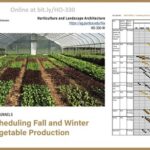
In April we announced a new bulletin “Scheduling Fall and Winter Vegetable Production in High Tunnels”, available from the Purdue Education store at https://edustore.purdue.edu/item.asp?Item_Number=HO-330-W . With the fall/winter high tunnel season underway we are now announcing it again. The publication brings together information collected on farms and research stations in Indiana and Ohio to provide…Read more about Scheduling Fall and Winter Vegetable Production in High Tunnels, Revisited[Read More]
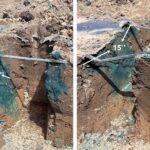
We discussed wetting patterns in drip irrigation in a previous article. The take home message is drip irrigation applies water to only a portion of the soil. Uneven water distribution in the soil profile is not a problem as long as enough water is applied to the crop. However, the water wetting pattern might influence…Read more about Water Affects Efficacy of Soil-Incorporated Fertilizers and Amendments[Read More]
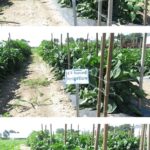
At Pinney Purdue (PPAC) bell peppers were harvested for the first time on August 15. Plants appear a little larger in the irrigated plots than in the unirrigated plots, but it is not obvious in photographs (Figure 1). Similar to what was observed at SWPAC, blossom end rot (BER) was much more common in the…Read more about Irrigation Demonstration Update July Aug. 24, 2022, Pinney Purdue Ag Center.[Read More]
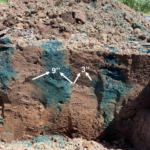
A major difference between drip irrigation and other irrigation methods is that drip irrigation applies water to only a portion of the soil. This works great for vegetables grown on the plastic mulch, since no irrigation water is applied between the row middles; water applied to row middles encourages weed growth. So, does the soil…Read more about Understanding Wetting Patterns in Drip Irrigation[Read More]

At Pinney Purdue (PPAC) 2.67 inches of rain fell July 27 through August 9. The potential evapotranspiration (PET) over the period was 1.68 inches. Estimates for water use by the crops are equal to or just slightly lower than potential evapotranspiration. For tomatoes, estimated water use was 1.68 inches, and for watermelons, 1.52 inches. There…Read more about Irrigation Demonstration Update Aug 9, 2022, Pinney Purdue Ag Center[Read More]
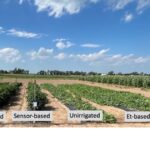
At Pinney Purdue (PPAC) 2.19 inches of rain fell July 12 through July 26. The potential evapotranspiration (PET) over the period was 2.67 inches. Estimates for water use by the crops are somewhat lower than potential evapotranspiration. For tomatoes, estimated water use was 2.03 inches, and for watermelons, 1.54 inches. Dry periods between heavy rains…Read more about Irrigation Demonstration Update July 27, 2022, Pinney Purdue Ag Center[Read More]
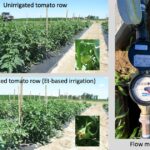
At Pinney Purdue (PPAC) 1.66 inches of rain fell June 25 through July 11. The potential evapotranspiration (PET) over the period was 2.79 inches. Estimates for water use by the crops are lower than potential evapotranspiration because it is only 5 weeks after transplanting. For tomatoes, estimated water use was 2.01 inches, and for watermelons,…Read more about Irrigation Demonstration Update — PPAC July 11[Read More]
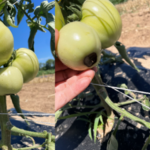
At Southwest Purdue Ag Center (SWPAC) and Pinney Purdue Ag Center (PPAC), we demonstrate irrigation impacts on several fruiting vegetable crops. Tomato, pepper, eggplant, watermelon, and cantaloupe are planted on plastic-covered beds with drip tapes. They grow on beds side-by-side with and without irrigation. We used two approaches to schedule irrigation, one bed is irrigated based on…Read more about Irrigation Demonstration Update June 25[Read More]