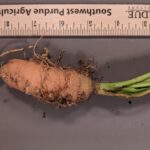
We announced in a previous newsletter article that we are doing a survey to understand the extent of root-knot nematode (RKN) damage on vegetable crops in Indiana. Among the 18 soil samples from high tunnels of 14 farms, RKNs (juvenile or adult) were found in 13 samples at 9 farms. Only 3 farmers knew RKN…Read more about Root-knot Nematode may be a Hidden Problem in High Tunnels[Read More]
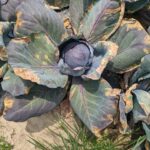
I have observed the disease black rot of cabbage and broccoli this year. I have discussed the basics of this disease in April (Issue 701). Here, I would like to share some photos and observations. For a brief background, black rot is a bacterial disease that becomes systemic-that is, moves within the plant. The disease…Read more about Black rot of Brassica Crops[Read More]
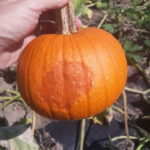
Pumpkin and winter squash should be harvested fully mature to reach their optimal quality and fulfill their potential shelf life. Characters indicating fruit maturity include loss of rind surface gloss, ground spot yellowing, and hardening of the skin to the level that it is resistant to puncture with a thumbnail. Except for some striped varieties,…Read more about Tips for Harvest and Postharvest of Pumpkin and Winter Squash[Read More]
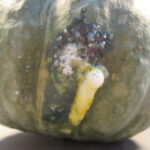
For a few years, I participated in the Squash Hunger Trial led by Dr. Annette Wszelaki, where we grew a wide range of winter squashes at multiple states. One year, I failed to manage insects, leading to a squash bug and cucumber beetle outbreak. The insects defoliated leaves (Figure 1) and caused cosmetic damage to…Read more about What Happened to the Winter Squash?[Read More]
Vegetable growers may be wondering when to apply the final fungicide application. It is important to leave the crop protected until the last harvest. Yet, it is important not to waste fungicides. In most cases, the last fungicide application should occur 10 to 14 days from the final harvest. Most fungicides that are designed to…Read more about The Final Fungicide Application[Read More]

We discussed wetting patterns in drip irrigation in a previous article. The take home message is drip irrigation applies water to only a portion of the soil. Uneven water distribution in the soil profile is not a problem as long as enough water is applied to the crop. However, the water wetting pattern might influence…Read more about Water Affects Efficacy of Soil-Incorporated Fertilizers and Amendments[Read More]
This article was originally published in the August 2022 Center for Crop Diversification Newsletter. Dakota Moore is the Grower Outreach Coordinator of Kentucky Horticulture Council. You can reach Dakota at dakota@kyhortcouncil.org “That’ll never happen to us.” “It’s always been this hot and dry.” “This storm won’t be that bad.” If the last year has taught…Read more about Protect Your Livelihood with Crop Insurance[Read More]
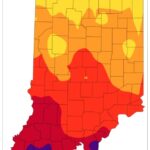
After another wet weekend and cooler temperatures to start this week, it may be surprising to hear that conditions will be changing back to warm and dry for the next several weeks. Climate models are strongly favoring above-normal temperature throughout the rest of September with a slight favoring of below-normal precipitation. Abnormally dry conditions continue…Read more about Warm, Dry Conditions Ahead[Read More]


Strawberry Chat in Sept. is about substrate production. You will learn the basics of substrate production and hear about two substrate strawberry production systems. Dr. Chieri Kubota and Mark Kroggel from The Ohio State University talk about root zone management in substrate production and introduce the greenhouse system. Richard Barnes is the owner of Tanglewood…Read more about Strawberry Chat Update[Read More]
Purdue University prohibits discrimination against any member of the University community on the basis of race, religion, color, sex, age, national origin or ancestry, genetic information, marital status, parental status, sexual orientation, gender identity and expression, disability, or status as a veteran. This material may be available in alternative formats. 1-888-EXT-INFO Disclaimer: Reference to products in this publication is not intended to be an endorsement to the exclusion of others which may have similar uses. Any person using products listed in this publication assumes full responsibility for their use in accordance with current directions of the manufacturer.