
I caught my first earworm (Figure 1) moth in a pheromone trap last week. Earworms are very polyphagous, meaning they will eat lots of different plants. I suspect that any females that are flying are laying their eggs on wild plants of some sort and not on the seedling stage sweet corn or dent corn that…Read more about Corn Earworm[Read More]
Found 1716 Articles
The cool, wet weather we are experiencing is perfect for the root and seed maggots, namely cabbage maggot, onion maggot, and seedcorn maggot. One way of avoiding damage from these pests is to wait until the soils warm up to 70o F before planting, but that is not always possible. The use of row covers…Read more about Root and Seed Maggots[Read More]
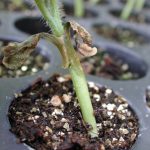
Gummy Stem Blight – this fungal disease causes dark brown leaf spots, however, the diagnostic feature of this disease is the water soaked lesion that is often formed under one of the seed leaves (cotyledons). Such lesions often start at the point where the seed leaf joins the stem (hypocotyl) and do not extend to…Read more about Cucurbit Transplant Diseases[Read More]
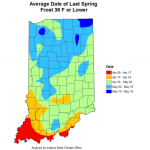
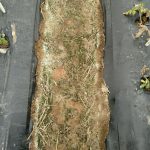
In a recent visit to a high tunnel, we observed a severe salinity problem on tomatoes. Approximately one month after planting , most tomato plants in the affected area had not sent out any new leaves. Roots did not grow at all (Figure 1). After conducting a soil test, very high soluble salt level explains…Read more about Salt Accumulation for Vegetable Production in High Tunnels[Read More]
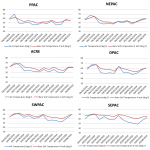
Soil temperatures are critical for seed germination and are closely related to occurrences of some early season soilborne disease and pest problems on vegetable crops. Plant vegetable crops after the soil is warm enough ensure good seed germination and fast crop establishment. The figures below show daily average soil and air temperatures at recorded at…Read more about Soil Temperatures in the Past Two Weeks[Read More]
Do you grow spinach or lettuce in Northwest Indiana? Drs. Lindsay Gielda and Scott Bates in the Dept. of Biological Sciences at Purdue University Northwest would like to collect a few samples from your farm. They are studying how the endosymbiotic fungi that naturally live on spinach and lettuce might inhibit the growth of pathogenic E. coli strains…Read more about Researchers Looking for Spinach and Lettuce from NW Indiana[Read More]
Every year since 1980, we have conducted watermelon and cantaloupe variety trials at Southwest Purdue Agricultural Center. In 2016, our variety trials include 44 standard seedless watermelons, 12 cantaloupes, 4 mini-sized seedless watermelons, and 5 seeded watermelon varieties. Seeds have already been planted in the greenhouses and our target date for transplanting in the field…Read more about 2016 Watermelon and Cantaloupe Variety Trials at Southwest Purdue Agricultural Center[Read More]
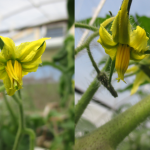
Maintaining temperature in the ideal range is very important for tomato fruit set. The optimum temperatures are 60-75°F (night) and 60-90°F (day). Studies showed that exposing plants to 3-h periods of temperatures above 104°F on two successive days may caused fruit set failure. Not only is the maximal temperature critical for fruit set, maintaining night temperature…Read more about Understanding High Temperature Effects on Fruit Set of Tomatoes[Read More]
High Tunnel Tour at SWPAC Location: Southwest Purdue Agricultural Center, 4369 North Purdue Road, Vincennes, IN 47591 Date: May 9, 2016, 3:00 PM to 5:00 PM EST Please join us for a high tunnel tour at Southwest Purdue Agricultural Center. You will see state-of-the-art high tunnels, learn about season extension of strawberry production under high tunnels and…Read more about Upcoming Events[Read More]
Purdue University prohibits discrimination against any member of the University community on the basis of race, religion, color, sex, age, national origin or ancestry, genetic information, marital status, parental status, sexual orientation, gender identity and expression, disability, or status as a veteran. This material may be available in alternative formats. 1-888-EXT-INFO Disclaimer: Reference to products in this publication is not intended to be an endorsement to the exclusion of others which may have similar uses. Any person using products listed in this publication assumes full responsibility for their use in accordance with current directions of the manufacturer.