As predicted last week, I have received a number of reports of damage to various vegetables from the root and seed maggots. These pests need to be managed preventively. First, by limiting the amount of decaying organic matter (cover crops, compost, manure) that attracts the flies, growers can reduce the number of eggs laid. Second,…Read more about Root and Seed Maggots[Read More]
Found 1716 Articles
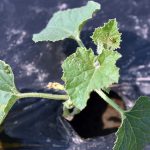
We found our first striped cucumber beetle on Friday, May 20 and several more on May 23 (Figure 1). Given the cool weather, this is a little earlier than we would have expected. As the temperatures warm up this week, it would not be surprising for cucumber beetles to become very numerous in our melon…Read more about Striped Cucumber Beetles[Read More]
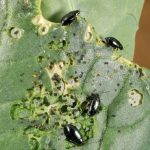
Many of our vegetable crops are subject to feeding by one or more species of flea beetles (Figure 1). Flea beetles get their name because they have enlarged hind legs that allow them to jump like fleas. Most species are quite small, and with their ability to jump, often seem to just disappear when disturbed….Read more about Flea Beetles[Read More]
The cool weather this spring means that many early-planted warm season crops have probably been stressed by cool temperatures more than usual. A number of herbicides labeled for vegetable crops include warnings not to use when the crop is or will be under stress. A stressed crop may not be able to detoxify the herbicide…Read more about Cool Temperatures and Excess Rain may Increase Crop Injury from Labeled Herbicides[Read More]
Purdue Extension publication PPP-110 ‘Options for Dealing with a Pesticide Drift Incident’ describes causes and effects of pesticide drift. It discusses actions a vegetable farmer (or anyone) might take if they suspect that herbicide drift may have injured their crop. The first step suggested is to find out what caused the symptoms. The publication explains…Read more about New Purdue Publication About Pesticide Drift[Read More]
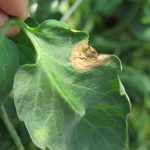
The recent cool and cloudy weather has influenced conditions in the field as well as in greenhouses and high tunnels. I have observed more Botrytis gray mold of tomatoes in greenhouses this spring than usual. This is due in part to the weather. This article will discuss this disease on tomatoes and some management options….Read more about Botrytis Gray Mold on Greenhouse Tomatoes[Read More]
With the 2016 growing season upon us, many produce growers will soon be collecting water samples from irrigation and postharvest water sources for microbiological analysis. Using proper techniques to collect water samples will help to prevent inaccurate testing results. When collecting water samples, one should start with the appropriate collection container. Many laboratories will only…Read more about Be Sure to Use Proper Techniques When Collecting Water Samples[Read More]
Foliar diseases of cantaloupe and watermelon can be a major negative impact on yield and fruit quality. This article will discuss management tools including cultural measures and fungicide schedules. Know the foliar diseases that are likely to become a problem for Indiana production. The three most common foliar diseases of cantaloupe and watermelon are: Alternaria…Read more about Fungicide Spray Schedule for Cantaloupe and Watermelon[Read More]
Beginning Farmer Tours May 26, 2016: South Circle Farm, Indianapolis. Urban agriculture, organic farming and key tools for managing small-scale farming operations. June 25, 2016: Silverthorn Farm, Rossville. Organic fruits and vegetables, pastured pork and working with restaurants. July 14, 2016: Melon Acres, Oaktown. Community-supported agriculture and agritourism. Sept. 29, 2016: River Ridge Farm, Roann. Four-season vegetable farming, operating…Read more about Upcoming Events[Read More]
The cost of high tunnel and greenhouse infrastructure is high. The purchase price of high tunnels can vary between $2.00 and $7.00 per square foot, while climate controlled greenhouse costs can vary between $7.00 and $30.00 per square foot. Several factors have an impact on the costs of setting up new high tunnel or greenhouse…Read more about Cost Considerations Prior to the Purchase of a High Tunnel or Greenhouse[Read More]
Purdue University prohibits discrimination against any member of the University community on the basis of race, religion, color, sex, age, national origin or ancestry, genetic information, marital status, parental status, sexual orientation, gender identity and expression, disability, or status as a veteran. This material may be available in alternative formats. 1-888-EXT-INFO Disclaimer: Reference to products in this publication is not intended to be an endorsement to the exclusion of others which may have similar uses. Any person using products listed in this publication assumes full responsibility for their use in accordance with current directions of the manufacturer.