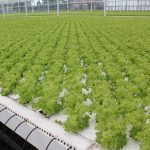
Travelling through Indiana last summer, I realized that many growers plant their crops in soil inside their high tunnels or greenhouses. Soilless production offers different benefits and challenges. This is the first article in a series focusing on soilless crop production in high tunnels and greenhouses. Today we are discussing Hydroponics. What is Hydroponics? The…Read more about Opportunities in Hydroponics[Read More]
Found 1716 Articles
In recent years, many seed companies have begun using the neonicotinoid insecticide thiamethoxam (FarMore) as a seed treatment on cucurbit and other vegetable seeds. Thiamethoxam is a systemic insecticide that moves from the seed coat into the seedling and then moves throughout the plant. Research has shown that these seed treatments provide about 3 weeks…Read more about Neonicotinoid Seed Treatment on Cucurbits[Read More]
One way insects communicate with individuals of the same species is with pheromones. Pheromones are volatile chemicals released by an insect that usually can be detected only by individuals of the same species. There are a number of different types of pheromones, but the most common type is the sex pheromone. Usually the females will…Read more about Pheromones and Pheromone Traps[Read More]
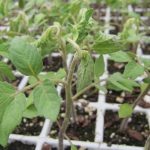
Tomatoes grown in controlled environment are exposed to conditions that are different from their original habitats. As a result, varieties that are not specifically bred for greenhouse production may respond to the controlled environment with abnormal symptoms. One group of the symptoms is called edema. Bumps, galls or blisters develop on tomato leaves, petioles or…Read more about Edema on Tomato Rootstocks[Read More]
If you are an Indiana beekeeper and if you are under 22, please note the 2016 Young Beekeeper of the Year Award This is a statewide contest with great prizes. Application procedure and additional information can be found at YBA Information-Application Form. Application deadline is September 1, 2016.
Updates to the MW Vegetable Production Guide for Commercial Growers 2016 (ID-56)-The table below gives the changes that have been made to the on-line version of the ID-56 as of this date. If you have purchased, or will purchase, a hard copy of this guide, please make these changes. If you use the ID-56, these…Read more about Updates to the 2016 MW Vegetable Production Guide for Commercial Growers[Read More]
New fungicide – I would like to announce the release of a new fungicide, Orondis® from Syngenta. It is a good product and should help commercial vegetable growers in combating downy mildew of cucurbits, Phytophthora blight of cucurbits, peppers and tomato, Buckeye rot of tomato and late blight of potato and tomato. However, I also want to…Read more about New Fungicide for Vegetables[Read More]
If you received a hard copy of the Midwest Cantaloupe Variety Trial in Southwest Indiana-2015 at the Southwest Indiana Melon and Vegetable Growers Technical meeting in December, 2015, please note there was a mistake in Table 3, the firmness and fruit size columns. The corrected version of this report is available at https://ag.purdue.edu/hla/fruitveg/MidWest%20Trial%20Reports/2015/02-01_Guan_Cantaloupe.pdf. We are…Read more about Correction of the 2015 Cantaloupe Variety Trial Report in Southwest Indiana[Read More]
If you are an organic grower and use manure and compost, you might be interested in spending a few minutes to participate this survey conducted by University of California-Davis, The Organic Center and Organic Trade Association. The purpose of the survey is to characterize the use of manure and compost based soil amendments. Results from…Read more about Survey about the Use of Manure and Compost[Read More]
2016 Indiana Small Farm Conference Location: Danville, Indiana Date: March 3 to 5, 2016 Keynote speaker of this year’s conference is Mary Dee Berry the executive director of The Berry Center, and Ben Hartman the author of The Lean Farm. More information regarding registration, conference schedule, as well as directions and lodging is available at…Read more about Upcoming Events[Read More]
Purdue University prohibits discrimination against any member of the University community on the basis of race, religion, color, sex, age, national origin or ancestry, genetic information, marital status, parental status, sexual orientation, gender identity and expression, disability, or status as a veteran. This material may be available in alternative formats. 1-888-EXT-INFO Disclaimer: Reference to products in this publication is not intended to be an endorsement to the exclusion of others which may have similar uses. Any person using products listed in this publication assumes full responsibility for their use in accordance with current directions of the manufacturer.