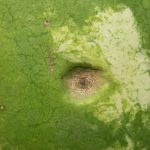
Late in the 2015 season, I observed some unusual symptoms of anthracnose on watermelon fruit. I wanted to discuss these symptoms, but first a little background of cucurbits. An extension bulletin on this subject may be found at https://www.extension.purdue.edu/extmedia/bp/bp-180-w.pdf. Anthracnose of cucurbits, caused by Colletotrichum orbiculare, is responsible for lesions on leaves, stems and fruit. Crops affected…Read more about Symptoms of Anthracnose of Watermelon on Fruit[Read More]
Found 1716 Articles
There are certain questions within our culture for which there are simply no good answers. For example, how many times have we heard the classic question, “If a tree falls in a woods and there’s no one to hear it, does it still make a sound?” One question I’ve been asked recently, for which the…Read more about Managing Manure – How Long is Long Enough?[Read More]
Recently the USDA announced the addition of a new third-party auditing service that will be available through the Ag Marketing Service (AMS). The service, called “GroupGAP”, will be available in the spring of 2016. The expansion of the service follows multi-year piloting and testing of the program. Under the GroupGAP program, independent farms may organize…Read more about USDA Announces the Addition of “GroupGap” to its Audit Services[Read More]

Consumers have many choices in today’s marketplace. Whether they are shopping in the your farm market, roadside stand, community farmers’ market or the local grocery store it makes no difference…busy shoppers can choose to buy fresh fruits and vegetables or any number of frozen or otherwise preprocessed (value added) foods. FoodLink, a FREE tool developed…Read more about Foodlink – A New Tool to Increase Farm Sales and Improve Shopper Knowledge about Specialty Crops[Read More]
The 2016 version of the Production Guide (ID-56) is on track to be completed by the first week in January 2016. The ID-56 is an annually updated Guide with recommendations on varieties, production practices, pesticides and more. To get your copy of the ID-56, either visit mwveguide.org or get a hard copy through the Purdue…Read more about Midwest Vegetable Production Guide For Commercial Growers 2016[Read More]
There is still time to submit a proposal to this grant program. The 2016 Farmer Rancher Grant Program of NCR SARE offers grants for farmer-initiated projects of up to $7,500 for individuals, $15,000 for partners, and $22,500 for groups. Grant applications are due in the NCR SARE office on Thursday, December 3, 2015. To learn…Read more about SARE Farmer Rancher Grant Deadling Coming Up[Read More]
The Southwest Indiana Melon and Vegetable Growers Association will hold their technical meeting and variety trial showcase on Thursday, December 3rd at the Southwest Purdue Ag Center, 4369 N. Purdue Road, Vincennes, IN. The meeting will start at 6:00 P.M., dinner will be served. At approximately 7:00 P.M., the variety trial discussion will begin. Any…Read more about SW Indiana Melon and Vegetable Growers Meeting[Read More]
Beginning Farmer Tour. Saturday, November 7, 2015. 9:00 A.M. – Noon CST. Perkins Good Earth Farm, DeMotte, IN. Breakfast, networking session, lunch, tour. Soil health, cover crops, vegetable and high tunnel production. Sponsored by Purdue Extension and Local Growers Guild. For more information and to register contact the Purdue Extension Education Store at https://www.edustore.purdue.edu/ or…Read more about Upcoming Events[Read More]

Amanda Deering started her Extension/Research appointment July 1, 2015 in a new role as a Clinical Assistant Professor in fresh produce food safety. Amanda grew up on a farm in a small farming community located in the “thumb” of Michigan and joined the Food Science department in the fall of 2013 as a Research Assistant…Read more about Dr. Amanda Deering Appointed to Fresh Produce Safety Extension Faculty Position[Read More]
Crop production, decomposition of organic matter, using ammonium-producing nitrogen fertilizers, and rainfall all lower soil pH. To maintain soil pH in the optimal range (6.5 to 6.8) for vegetable production, periodic application of lime is needed. The primary form of agricultural lime is calcium carbonate (CaCO3). It is the carbonate (CO3^2-) part that brings up…Read more about Liming[Read More]
Purdue University prohibits discrimination against any member of the University community on the basis of race, religion, color, sex, age, national origin or ancestry, genetic information, marital status, parental status, sexual orientation, gender identity and expression, disability, or status as a veteran. This material may be available in alternative formats. 1-888-EXT-INFO Disclaimer: Reference to products in this publication is not intended to be an endorsement to the exclusion of others which may have similar uses. Any person using products listed in this publication assumes full responsibility for their use in accordance with current directions of the manufacturer.