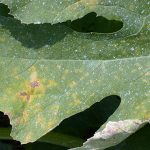
On July 22, I announced that downy mildew had been observed on watermelon in Knox County in southwestern Indiana. This article https://ag.purdue.edu/arp/swpap/VeggieDiseasesBlog/Lists/Posts/Post.aspx?ID=48 describes the outbreak and management options. Below, I will discuss the whereabouts of additional downy mildew outbreaks on cucurbits. Downy mildew has now been reported on cucumber in Knox and La Porte County Indiana….Read more about Downy Mildew Update[Read More]
Found 1707 Articles
Pumpkins are off to good start and vines are starting to run, which means it is time to think about making a sidedress application of nitrogen. Typically, I recommend to split nitrogen applications half preplant and half sidedress. This is especially beneficial given all of our rain this season. If you relied on preplant N alone, with…Read more about Mid-Season Nitrogen Management in Pumpkins[Read More]
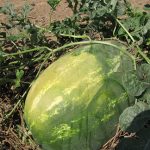
Loss of foliage due to poor growing conditions or disease can cause fruit to be exposed to the sun. Hot temperatures and direct sunlight can lead to areas of the fruit that appear bleached or sunburned. Sunburned fruit may not be marketable. To reduce the probability sunburned fruit, every effort should be made to maintain foliage…Read more about Sunburn on Vegetables[Read More]
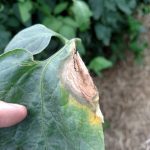
Gray mold of tomato is one of the more common diseases of greenhouse-produced tomatoes. Although it is often a minor problem, if left unchecked, gray mold can cause yield loss. Gray mold, or more properly, Botrytis gray mold, often causes a light gray or brown necrotic lesion on leaves (Figure 1). The lesions on leaves are sometimes…Read more about Botrytis Gray Mold of Tomato[Read More]
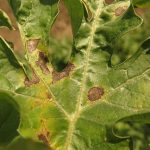
This disease has been observed on watermelon in Knox County. The following article will discuss the symptoms, biology and management of downy mildew of cucurbits. Symptoms. The symptoms of downy mildew vary depending on the host. On watermelon, the lesions start out as chlorotic (yellow) areas that become round and necrotic (brown/black) areas surrounded by…Read more about Downy Mildew of Watermelon[Read More]
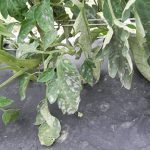
This disease has been reported near West Lafayette and in Wanatah Indiana. Powdery mildew of tomato can be recognized by the white fungal colonies on both leaf surfaces (Figure 1). Occasionally, stems may also be infected. Severely affected tomato plants may have leaves that turn chlorotic and necrotic. Fruit will not be directly affected. The causal organism has been…Read more about Powdery Mildew of Tomato[Read More]
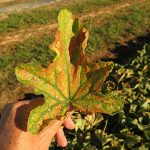
I have observed many fields of cantaloupes with magnesium deficiency or manganese toxicity. Watermelon plants may exhibit similar symptoms, but not as frequently as cantaloupe. Both disorders are related to acid (low pH) soils and usually occur in clusters in a field. Magnesium deficiency usually appears on sandy ridges and can be recognized by interveinal…Read more about Magnesium and Manganese in Melon[Read More]

Pinney Purdue Vegetable Field Day and Sweet Corn Sampler. Thursday, August 13, 2015. 4:00 p.m. – 8:00 p.m. CDT. Pinney Purdue Ag Center, 11402 S. County Line Rd., Wanatah, IN. Plot tours include soil health management and disease suppressive soils, tomatoes and peppers in high tunnels, and sweet corn varieties. Private Applicator Recertification (PARP) Credit…Read more about Upcoming Events[Read More]
In years past, the European corn borer was the most important pest of sweet corn, as well as being a pest of peppers and other vegetables. Since the advent of Bt field corn, the overall population of corn borers has been dramatically suppressed, so far that we often forget about it being a pest of…Read more about European Corn Borer[Read More]
We are again seeing a lull in pheromone trap catches of corn earworms. However, I caution sweet corn growers to remain vigilant in checking their traps. Populations can increase rapidly, especially if carried north on storm fronts from the Gulf Coast. It is also important to watch the development of the field corn around your…Read more about Corn Earworm[Read More]
Purdue University prohibits discrimination against any member of the University community on the basis of race, religion, color, sex, age, national origin or ancestry, genetic information, marital status, parental status, sexual orientation, gender identity and expression, disability, or status as a veteran. This material may be available in alternative formats. 1-888-EXT-INFO Disclaimer: Reference to products in this publication is not intended to be an endorsement to the exclusion of others which may have similar uses. Any person using products listed in this publication assumes full responsibility for their use in accordance with current directions of the manufacturer.