After harvest, storing vegetables in optimal conditions is important to ensure the whole season’s hard work has paid off. This article discusses the optimum storage conditions for tomato, pepper, cucumber, watermelon, cantaloupe and sweet corn. Tomato Ideal storage conditions for tomatoes depend on the maturity stage of picking. If tomatoes are picked at mature green,…Read more about Optimal Storage Conditions for Vegetables[Read More]
Found 126 Articles
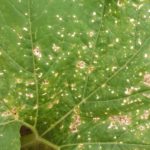
I have observed this disease in scattered commercial pumpkin and squash fields across Indiana. Bacterial leaf spot of pumpkin is perhaps the most serious disease of pumpkin in Indiana today. Symptoms: Bacterial spot causes ⅛-¼ inch angular leaf lesions that are white to light brown in color (Figure 1). These leaf lesions may be accompanied…Read more about Bacterial Spot of Pumpkin[Read More]
Populations of earworms, as evidenced by pheromone trap catches, have not gone to zero as the often due in July. Catches have been fairly low, but moths are still flying and presumably laying eggs. The good news is that in most areas, dent corn is silking, which attracts most of the moths away from our…Read more about Corn Earworms[Read More]

There are three important caterpillar pests of crucifers in Indiana, the imported cabbageworm, the cabbage looper, and the diamondback moth. Each of these caterpillars will feed on leaves and heads. All are capable of producing serious damage to most crucifers. The adult imported cabbageworm is a common white butterfly with black spots on the forewing…Read more about Caterpillars in Crucifers[Read More]
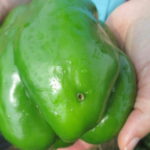
European corn borers used to be a serious pest of peppers. The larvae would burrow into the fruit under the cap, making it difficult to cull out infested fruit. With the widespread adoption of Bt corn by agronomic farmers, populations of corn borers have been greatly reduced. However, it appears that in the last couple…Read more about Caterpillars in Peppers[Read More]
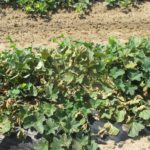
Manganese toxicity is a common problem for cantaloupes growing in sandy soils across southwestern Indiana. Because symptom of manganese toxicity can easily be confused with foliar diseases, growers may misdiagnose the problem and waste fungicides by spraying for nonexistent diseases. As we now know that manganese toxicity is a nutrient related disorder caused by low…Read more about Manganese Toxicity on Cantaloupes[Read More]
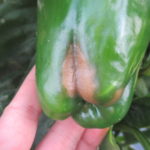
In the past few weeks, we have received several reports about blossom end rot on tomatoes and peppers as the crops start to set fruit. Blossom end rot is a physiological disorder (not an infectious disease) that commonly occurs on tomatoes and peppers. Initial symptoms of the physiological disorder include dark green or brown water-soaked leisure…Read more about Blossom End Rot of Tomato and Pepper[Read More]
I have observed very few foliar diseases of cucurbits this season. However, I have had several worried phone calls about these diseases, so here is an update. Alternaria leaf blight-this disease is caused by a fungus that survives in crop residue. It usually is not an important disease. However, Alternaria can cause brown lesions with…Read more about Foliar Disease of Cucurbit Update[Read More]
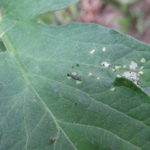
We are seeing small caterpillars feeding on tomato leaves in high tunnels at Pinney Purdue. The first sign may be feeding partially through the leaf, or ‘windowpane’ feeding, or small holes on the leaf. By turning the leaf over we find a yellowstriped armyworm or hornworm (Figures 1 and 2). In the morning, we find…Read more about Caterpillars on High Tunnel Tomatoes[Read More]
When we first began working in high tunnels about 8 years ago, most of the popular literature said that the tunnels would provide protection from most insect pests, other than the usual greenhouse pests like aphids and mites. What we found very quickly is that that information was untrue. We found very high populations of…Read more about Caterpillars in High Tunnels[Read More]
Purdue University prohibits discrimination against any member of the University community on the basis of race, religion, color, sex, age, national origin or ancestry, genetic information, marital status, parental status, sexual orientation, gender identity and expression, disability, or status as a veteran. This material may be available in alternative formats. 1-888-EXT-INFO Disclaimer: Reference to products in this publication is not intended to be an endorsement to the exclusion of others which may have similar uses. Any person using products listed in this publication assumes full responsibility for their use in accordance with current directions of the manufacturer.