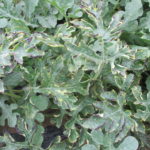
Watermelon harvest is in full swing in southern Indiana. At this time, we frequently see many types of leaf symptoms. Some of them are caused by foliar diseases, such as anthracnose, Alternaria leaf blight and gummy stem blight. These diseases require special attention, normally in the form of fungicide sprays, to slow spread of the…Read more about Not All the Watermelon and Cantaloupe Leaf Symptoms are caused by Pests[Read More]
Watermelon
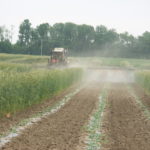
MELCAST is a weather-based disease-forecasting program that helps growers schedule foliar fungicides. MELCAST stands for MELon disease forCASTer. This program, designed by Dr. Rick Latin, Professor of Plant Pathology at Purdue University, keeps track of weather conditions so that cantaloupe and watermelon growers can apply foliar fungicides to their crops when they are most needed….Read more about MELCAST 2018[Read More]
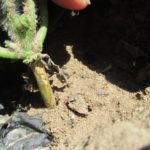
This article provides more detailed information about this herbicide. How does Chateau® herbicide work Chateau® is a group 14 mode-of-action herbicide. Compounds in this group are most active on broadleaf weeds. Before Chateau® became available, no other preemergence herbicide with the same mode of action was labeled for use in watermelons and cantaloupes. The active…Read more about Chateau Herbicide for Use in Melon Production[Read More]
Chateau SW® herbicide now has a 24(c) special local needs label for cucurbits. This product is produced by Valent, but the label is held by the Indiana Vegetable Growers Association (IVGA). To obtain a label, one must be a member of the IVGA, pay an annual $100 processing fee, read and understand the ‘conditions for…Read more about Chateau Herbicide SW 24(c) label[Read More]
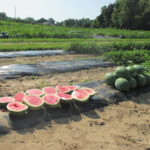
Seedless watermelon variety trials have been conducted at the Southwest Purdue Agricultural Center in Vincennes, IN for more than 20 years. In 2017, we evaluated the performance of 37 standard size seedless watermelon varieties and 4 mini watermelon varieties. This article introduces the top performing varieties in our trial in 2017. Standard size seedless watermelons…Read more about Top Performing Watermelon Varieties in the 2017 Indiana Watermelon Variety Trial[Read More]
After harvest, storing vegetables in optimal conditions is important to ensure the whole season’s hard work has paid off. This article discusses the optimum storage conditions for tomato, pepper, cucumber, watermelon, cantaloupe and sweet corn. Tomato Ideal storage conditions for tomatoes depend on the maturity stage of picking. If tomatoes are picked at mature green,…Read more about Optimal Storage Conditions for Vegetables[Read More]

Watermelon production is threatened by Fusarium wilt, a widely distributed soilborne disease that can cause yield losses up to 100%. Currently, there are no watermelon varieties that are completely resistant to all races of Fusarium wilt. One way to control the disease is through grafting. The grafted plant combines a watermelon cultivar with a squash…Read more about Opportunities for Growing Grafted Watermelons[Read More]
Many cantaloupe and watermelon growers have transplanted seedlings to the field. Soon, these growers will have questions about what and when to apply fungicides. The article below in this issue of the Vegetable Crops Hotline will address what fungicides to apply (Fungicides schedules for cucurbits). This article discusses when to apply fungicides with the MELCAST system….Read more about MELCAST 2017[Read More]

Many cantaloupe and watermelon growers are either growing transplants in a greenhouse or are expecting delivery of transplants in the next few weeks. Either way, growers should inspect transplants for disease before planting in the field. Below I will describe several common transplant diseases of cantaloupe and watermelon as well as management options. Gummy stem…Read more about Cantaloupe and Watermelon Transplant Diseases[Read More]
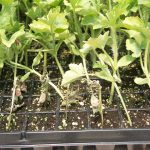
Fusarium wilt is one of the most serious diseases of watermelon in the Midwest. The disease often causes a one-sided wilt 2-3 weeks after transplanting. Whether a plant is affected, and to what degree, depends on the population of the long-lived spores in the soil that the roots contact. However, Fusarium wilt of watermelon is…Read more about Evidence for Spread of Fusarium Wilt of Watermelon in Transplant Trays[Read More]