As part of a multi-state effort being headed by Dr. Ian Kaplan at Purdue University in the Department of Entomology, we are investigating how to best manage insect pests on cucurbits, in our case watermelons, while having the least possible impact on pollinators. The research is being funded through the USDA/NIFA Specialty Crop Research Initiative….Read more about Purdue Looking for Watermelon Growers to Collaborate on Research Study[Read More]
Watermelon
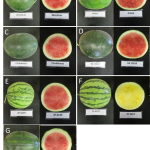
— Notes from Watermelon Research and Development Group Annual Meeting and 2016 Indiana Watermelon Variety Trial We are proud to be in Vincennes, the heart of watermelon producing counties in Indiana. In case you are unfamiliar with watermelon production here, Indiana is just behind Florida, Texas, Georgia, California and South Carolina in watermelon production nationwide….Read more about Watermelon Variety Considerations[Read More]
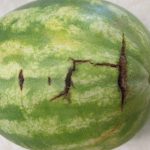
Cross stitch of watermelons is a physiological disorder (not caused by an infectious disease) first reported in 1990s on watermelon fruit. It received the name because the symptom looks like cross stitch. One or more rows of oval-shaped lesions lie along with the longitudinal axis of the fruit. These lesions are normally more close to…Read more about Cross Stitch of Watermelons[Read More]
For many vegetable growers, the season is in full swing. All that hard work in season preparation, planting and maintenance is paying off with harvest. One of the on-going season maintenance issues is applying fungicides. In other articles, I have described how and when to spray. In this article, I want to address when to stop. To limit the scope…Read more about When to Stop Spraying Fungicide[Read More]
This disease is more likely to develop during periods of heavy rains in relatively poorly drained soils. June started out dry for many areas of Indiana, however recent rains increase the likelihood of Phytophthora diseases. Phytophthora fruit rot of watermelon causes large, soft areas to develop on mature watermelon fruit. These lesions can be several inches…Read more about Phytophthora Fruit Rot of Watermelon[Read More]

White mold of watermelon – Usually when I write about a vegetable disease it is because the disease may cause important economic loss. Once in a while, however, a disease I find is more a curiosity than a real problem. So, go ahead and read this article about white mold of watermelon. But please don’t worry about…Read more about White Mold of Watermelon[Read More]
Read more about White Mold of Watermelon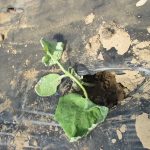
Last week, we received calls from several watermelon growers who reported that their newly planted watermelon seedlings had died (Figure 1). After closely inspecting the affected plants, we did not find any pathogens. This reminded us of what happened to our cucumbers back in early April in our high tunnel. We will review the cucumber…Read more about Establishment Failure of Watermelon and Cucumber Transplants Because of Low Soil Temperatures[Read More]
The cool, wet weather we are experiencing is perfect for the root and seed maggots, namely cabbage maggot, onion maggot, and seedcorn maggot. One way of avoiding damage from these pests is to wait until the soils warm up to 70o F before planting, but that is not always possible. The use of row covers…Read more about Root and Seed Maggots[Read More]
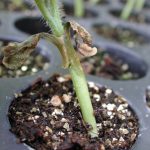
Gummy Stem Blight – this fungal disease causes dark brown leaf spots, however, the diagnostic feature of this disease is the water soaked lesion that is often formed under one of the seed leaves (cotyledons). Such lesions often start at the point where the seed leaf joins the stem (hypocotyl) and do not extend to…Read more about Cucurbit Transplant Diseases[Read More]
Every year since 1980, we have conducted watermelon and cantaloupe variety trials at Southwest Purdue Agricultural Center. In 2016, our variety trials include 44 standard seedless watermelons, 12 cantaloupes, 4 mini-sized seedless watermelons, and 5 seeded watermelon varieties. Seeds have already been planted in the greenhouses and our target date for transplanting in the field…Read more about 2016 Watermelon and Cantaloupe Variety Trials at Southwest Purdue Agricultural Center[Read More]