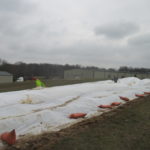
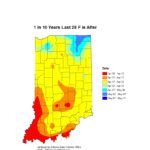
Strawberries growing in the matted-row system are in the blooming stage. Open flowers cannot tolerate temperatures lower than 30°F (Figure 1). Strawberry growers should be prepared for the coming low temperatures this week. Row covers (Figure 2) can be effective in protecting strawberry flowers. In our earlier trial, 1.5 oz/sq row covers provided 4-6 degrees…Read more about Using Row Cover or Sprinkler Irrigation for Cold Protection of Strawberries[Read More]
Climate and Weather
The Climate Prediction Center’s outlook for May is dominated by uncertainty regarding both temperature and precipitation (Figure 1). The computer models could not settle on a consistent pattern for either above- or below-normal temperatures for the month and precipitation outlooks are only slightly confident that there will be above-normal precipitation in southern Indiana. Shorter-term outlooks…Read more about Uncertain Climate Outlook for May[Read More]
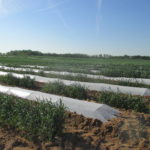
Two types of injury on young warm-season vegetable plants are caused by low temperatures: frost/freezing injury and chilling injury. Frost/freezing injury occurs when temperatures drop below 32°F. Ice formation in plant tissue cuts cell membranes. When the tissue thaws, the damage results in fluids leaking from the cell, causing water soaked damage. Frost/freezing injury is…Read more about Protect Early Planted Warm-Season Vegetables from Low Temperatures[Read More]
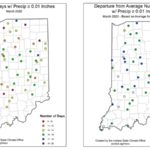
Staying true to global climate trends these days, March 2020 finished warmer and wetter than the 1981-2010 climate normal period. Snowfall across the state was below normal and localized flooding was a common feature. There were 3-to-5 more days than average in March where rainfall was observed. This has led to saturated soils throughout the…Read more about Was March any Indicator of the Next Few Months?[Read More]
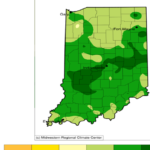
Meteorological winter (December-February) is finally over and we can start looking forward to spring. Across Indiana, winter brought above average precipitation (Figure 1), though below average snowfall. The temperatures were slightly above normal (2°F-6°F; Figure 2) with no record-breaking cold periods. Since there were so few colder-than-normal periods, the overwintering of pests and therefore increased…Read more about The Winter in Review with a Spring Outlook[Read More]

When I was very young, I remember my father talking about “knee high by the Fourth of July”. As I got older I thought that expression was so strange for it seemed the corn was usually “man high” by the Fourth of July. Obviously, the excessive rains and cooler temperatures have had an impact this…Read more about Indiana Climate and Weather Report[Read More]

So far for the month of May, temperatures across the state vary by nearly 2˚F above normal in the southeast and almost 3˚F below normal in the extreme northwest. Similarly, the same trends can be seen in the Modified Growing Degree Days as they are based on temperature (Figure 1). The main story continues…Read more about Indiana Climate and Weather Report[Read More]

The biggest topic seems to be how wet it is and how much more rain Indiana can expect. So far, May has experienced near-normal precipitation throughout the central part of the state with 0.5”-2” in southern and northern regions (Figure 1). Combining this with April’s precipitation, however, means the soil moisture is still 60mm to…Read more about Indiana Climate and Weather Report[Read More]

No reason exists to expect drought anytime soon in Indiana, with much of the state remaining rather wet after last weekend’s showers. One good new development exists. The precipitation pattern that has existed since nearly January seems to be becoming a little less predictable, which could mean more periods of drier weather between fronts on…Read more about Indiana Climate and Weather Report[Read More]
The rain seems to keep falling, barely providing time for things to dry out and start planting! The last few weeks has experienced up to 2” above normal precipitation – particularly for west-central and southern Indiana, which is near the 125th-125th percentile. Warm days seem to be relatively few and far between, causing a slow…Read more about Indiana Climate and Weather Report[Read More]