A few weeks ago, the Great Lakes Vegetable Producer’s Network discussed hoophouse nutrient management. Judson Reid from Cornell University and David Van Eeckhout from The Good Acre, St. Paul, MN, were the invited speakers. They shared their insights. I find them very helpful, so I want to pass my notes on to Indiana hoophouse growers….Read more about Hoophouse Nutrient Management — Notes from Great Lakes Vegetable Producer’s Network Weekly Roundtable Discussion[Read More]
Greenhouses & High Tunnels
At Southwest Purdue Agriculture Center in Vincennes, IN. We are conducting trials to evaluate annual plasticulture strawberry production systems. Here are the updates of strawberries from different production systems. In a high tunnel, harvest of fall-planted strawberries started in early April. Cultivars Sensation, Radiance, Ruby June were early cultivars; followed by Beauty, Fronteras. So far,…Read more about Annual Plasticulture Strawberry Update at Southwest Purdue Agriculture Center[Read More]
Thanks to the support from NC-SARE, we are going to continue the study of evaluating grafted cucumbers for early season production in greenhouses and high tunnels by collaborating with farmers in 2020. You can find our 2019 on-farm trials’ summary here: https://ag.purdue.edu/arge/swpap/Documents/Summary%20of%202019%20On-farm%20Grafted%20Cucumber%20Trials.pdf. The same as in previous years, we are going to supply grafted and…Read more about Call for Growers’ Participation of Grafted Cucumber Research[Read More]
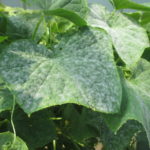
Powdery mildew is particularly severe in high tunnel and greenhouse growing conditions (Figure 1). It affects a wide range of crops including tomatoes and cucumbers. In addition to using synthetic fungicides to control this disease in high tunnels, we found powdery mildew on cucumbers can also be effectively controlled through variety selection and intensive plant…Read more about Variety Selection is Important for Managing Cucumber Powdery Mildew in High Tunnels[Read More]
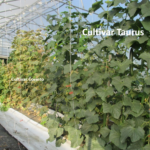
Supported by NC SARE (LNC17-390), we are continuing research for improving high tunnel cucumber production. One of the biggest challenges for growing cucumbers in high tunnels in the summer is two-spotted spider mites. Dry and hot environments featured in high tunnels allow two-spotted spider mite populations to increase rapidly. The mites cause leaf yellowing, necrosis,…Read more about Watch for Two-spotted Spider Mites on High Tunnel Cucumbers[Read More]
Basic Aspects of High Tunnel Soil Fertility Management – (Petrus Langenhoven, plangenh@purdue.edu, 765-496-7955) – Spring has arrived! Every high tunnel grower is now thinking of planting summer vegetable crops in high tunnels or has already planted. Whichever scenario applies to you, I hope that you have submitted soil samples or are in the process of…Read more about Basic Aspects of High Tunnel Soil Fertility Management[Read More]
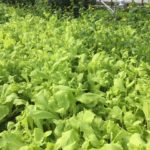
Bolting of crops overwintered in high tunnels is common in the spring. ‘Bolting’ refers to lengthening and blooming of the flowering stalk. Bolting is often a problem because the quality of the marketable part of the plant declines. Also, plants subject to bolting are programmed to die once they complete flowering and seed production so…Read more about Bolting and Blooming in High Tunnels[Read More]

High tunnels, though relatively new, have gained popularity over the past decade among specialty crop growers who want to extend their growing season. However, these environments can make crops vulnerable to the development of soil-borne diseases that reduce yield. This is particularly true for tomatoes, which are the most commonly grown high tunnel crop and…Read more about Dealing with Yield Decline in High Tunnel Tomatoes[Read More]
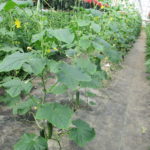
Cucumbers are extremely sensitive to cold. Locally grown cucumbers are almost only available in the summer. While in Asia, without the use of fancy heated greenhouses, cucumbers can grow all winter. Growing grafted cucumbers with cold tolerant squash rootstock is one of the key factors making this possible. Since 2016, we started to evaluate opportunities…Read more about Growing Grafted Cucumbers for Early Season Production in Protected Cultural Systems — Lessons Learned from on-farm Trials[Read More]
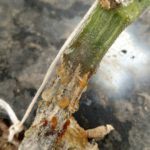
This disease was identified on a long Asian cucumber growing in a high tunnel in Mid-June in Knox County. The first symptom noted was wilting of the cucumber plant. Upon closer examination, a light, gray necrosis was observed on the lower portion of the plant. In Figure 1, you may notice dark spots in the…Read more about New Disease Report – Charcoal Rot of Cucumber[Read More]