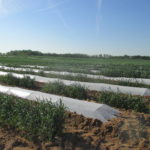
Two types of injury on young warm-season vegetable plants are caused by low temperatures: frost/freezing injury and chilling injury. Frost/freezing injury occurs when temperatures drop below 32°F. Ice formation in plant tissue cuts cell membranes. When the tissue thaws, the damage results in fluids leaking from the cell, causing water soaked damage. Frost/freezing injury is…Read more about Protect Early Planted Warm-Season Vegetables from Low Temperatures[Read More]
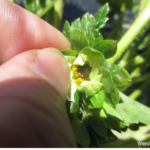
Spring weather is unpredictable. One of the major risks associated with strawberry production is cold damage in the spring. Open strawberry flowers can not tolerate temperatures lower than 30°F, popcorn stage flowers and tight buds may tolerant temperatures low to 26 and 22°F, respectively. If strawberries are in the early blooming stage, the damage might…Read more about Strawberry Cold Protection Made a Difference[Read More]
At Southwest Purdue Agriculture Center in Vincennes, IN. We are conducting trials to evaluate annual plasticulture strawberry production systems. Here are the updates of strawberries from different production systems. In a high tunnel, harvest of fall-planted strawberries started in early April. Cultivars Sensation, Radiance, Ruby June were early cultivars; followed by Beauty, Fronteras. So far,…Read more about Annual Plasticulture Strawberry Update at Southwest Purdue Agriculture Center[Read More]
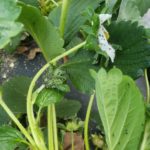
This winter-spring has been my first excursion into growing strawberries in a high tunnel. It didn’t take much for our own Wenjing Guan to convince me to plant some; who doesn’t love to eat fresh strawberries? We planted them back in October and I just peeked at them every couple of weeks throughout the winter,…Read more about Strawberry Observations from an Entomologist[Read More]
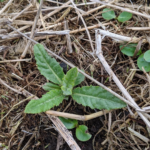
Spring is here and with it comes the emergence of weeds- especially problematic perennials like Canada thistle (Figure 1). Below is some information about Canada thistle and methods to manage it. Keep in mind two things: 1) many of these strategies will work for other perennial weeds, and 2) management of perennial weeds often requires…Read more about Canada thistle[Read More]
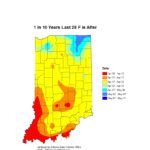
The Climate Prediction Center’s outlook for May is dominated by uncertainty regarding both temperature and precipitation (Figure 1). The computer models could not settle on a consistent pattern for either above- or below-normal temperatures for the month and precipitation outlooks are only slightly confident that there will be above-normal precipitation in southern Indiana. Shorter-term outlooks…Read more about Uncertain Climate Outlook for May[Read More]
Current stay-at-home orders in response to the COVID-19 pandemic mean more children are currently on farms or more regularly working them. A silver lining of farming families spending more time together is the opportunity to educate children about the farm workplace and establish a culture of safety.
Employment of youth under the age of 16 to work in agriculture is regulated by Federal Wage and Hour Laws. Youth ages 14 and 15, specifically, can perform certain farm tasks, not classified as hazardous, provided the work does not interfere with school (including completing online schooling) and appropriate wages are paid. Some tasks are recognized as particularly hazardous for youth and either cannot be performed by youth under the age of 16 at any time, or only after having first received special training.
Purdue University prohibits discrimination against any member of the University community on the basis of race, religion, color, sex, age, national origin or ancestry, genetic information, marital status, parental status, sexual orientation, gender identity and expression, disability, or status as a veteran. This material may be available in alternative formats. 1-888-EXT-INFO Disclaimer: Reference to products in this publication is not intended to be an endorsement to the exclusion of others which may have similar uses. Any person using products listed in this publication assumes full responsibility for their use in accordance with current directions of the manufacturer.