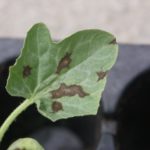
Many cantaloupe and watermelon growers are either growing transplants in a greenhouse or are expecting delivery of transplants in the next few weeks. Either way, growers should inspect transplants for disease before planting in the field. Below I will describe several common transplant diseases of cantaloupe and watermelon as well as management options. Gummy stem…Read more about Cantaloupe and Watermelon Transplant Diseases[Read More]
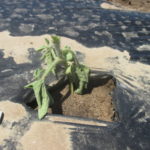
This is a newly released video about when to plant watermelons. https://youtu.be/tHT2mAnNRWk Watermelon, cantaloupe, cucumber plants are very sensitive to low temperatures. Even when frost has passed, soil temperatures below 60°F can result in transplant establishment failure. Check soil temperatures before planting. The rule of thumb is to plant watermelon, cantaloupe and cucumber transplants when…Read more about When to Plant Watermelons[Read More]
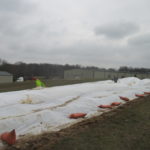
Strawberries growing in the matted-row system are in the blooming stage. Open flowers cannot tolerate temperatures lower than 30°F (Figure 1). Strawberry growers should be prepared for the coming low temperatures this week. Row covers (Figure 2) can be effective in protecting strawberry flowers. In our earlier trial, 1.5 oz/sq row covers provided 4-6 degrees…Read more about Using Row Cover or Sprinkler Irrigation for Cold Protection of Strawberries[Read More]
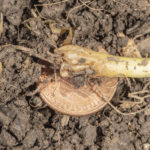
Each and every spring we get reports of poor seed emergence, seedling and transplant damage in early planted crops of all sorts. Most recently in untreated sweet corn, home gardens and transplanted onions. Lucky for us, we got to dive right into this pest and see them in action, but not so lucky for the…Read more about Seedling Damage by Maggot Pests[Read More]

Asparagus is one of the first field-grown Indiana vegetables on the market. This article reviews harvest, grading and postharvest care recommendations to help you start the season with top quality asparagus. Getting quality asparagus to market means making sure to pick good spears at the right time, grade according to your market requirements, and keep…Read more about Asparagus Harvest and Grading[Read More]
Dual Magnum® is registered for use in numerous row crops and specialty crops in the state of Indiana. While some vegetable crops (beans, peas, potatoes, pumpkins, rhubarb, and tomatoes) appear on the specimen or national label (Section 3 label), most do not. Numerous specialty crops that do not appear on the specimen label are included…Read more about Instructions on Finding the 24(c) Dual Magnum® Herbicide Label[Read More]
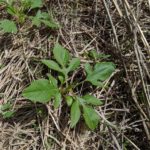
Scientific name: Ambrosia trifida Giant ragweed is a weed member of the sunflower family (Asteraceae) and native to the United States. It is extremely competitive and difficult to control in broadleaf crops. It emerges as early as March and continues to germinate through spring and early summer. Controlling giant ragweed during summer is not only…Read more about Giant Ragweed[Read More]
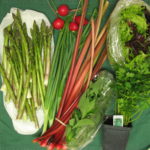
Farmers markets and farm stands will be opening soon if they aren’t already open. Vendors and market managers will be implementing new practices to reduce the spread of the novel corona virus. Guidelines for practices at Indiana farmers markets are summarized in a new publication from Purdue in cooperation with Indiana State Department of Health,…Read more about Keeping Produce Fresh at Markets and Farm Stands[Read More]
During the 2020 COVID-19 pandemic, farmers’ markets and farm stands are considered ‘essential businesses’ in Indiana. Therefore, statewide Executive Orders permit their operation during periods when only essential businesses may remain open, as long as proper social distancing measures are used. The guidelines below outline best practices for farmers’ markets in order to be considered…Read more about Farmers’ Market Guidelines for Social Distancing[Read More]
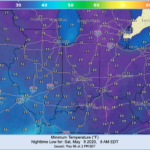
The earth’s position and movement around the sun welcomed the spring equinox on March 19th, and meteorologists in the northern hemisphere welcomed spring on March 1st. Unfortunately, the atmosphere – particularly over the midwestern and Great Lakes states – refused to acknowledge those dates to offer us a more traditional spring. Sure, Indiana’s spring 2020…Read more about Ready for Winter to Be Over[Read More]
Purdue University prohibits discrimination against any member of the University community on the basis of race, religion, color, sex, age, national origin or ancestry, genetic information, marital status, parental status, sexual orientation, gender identity and expression, disability, or status as a veteran. This material may be available in alternative formats. 1-888-EXT-INFO Disclaimer: Reference to products in this publication is not intended to be an endorsement to the exclusion of others which may have similar uses. Any person using products listed in this publication assumes full responsibility for their use in accordance with current directions of the manufacturer.