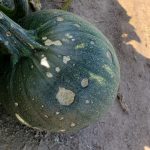
Question: What happened to these fruit? Answer: Hail damage. A storm that happened in middle July brought hail to parts of Indiana. Hail hit small fruit, and damage became pronounced as fruit grow. More information about the damage to vegetable crops can be found in the article Hail Damage published in Vegetable Crops Hotline Issue…Read more about Answer to Question from Last Issue (8-13-2020)[Read More]
Cucurbits
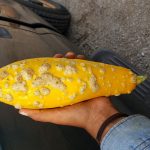
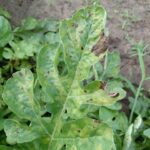
Downy mildew has been observed in LaPorte County in northern Indiana on cucumber. In addition, downy mildew on cucumber has been reported in southern Kentucky and on watermelon in the Kansas City area of Kansas. Growers in northern Indiana should manage for downy mildew on valuable cucurbit crops (Figure 1). Growers throughout the state should…Read more about Cucurbit Downy Mildew[Read More]
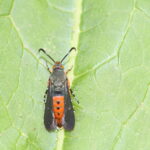
In the past two weeks we have heard reports of the Squash vine borer (Figure 1) being spotted in some local gardens. This pest of cucurbit crops tends to be sporadic in our region; you are either battling it every year or it hardly makes an appearance. The squash vine borer is a member of…Read more about Watch for a New Culprit Wilting Your Cucurbits![Read More]
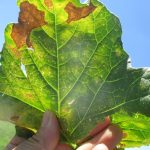
Manganese (Mn) toxicity was observed in a cantaloupe field at the Southwest Purdue Agricultural Center this year. This is a plant nutritional disorder related to acid soils and it usually occurs in clusters in a field. A plant tissue test confirmed that the Mn level in the leaves of the affected plants was 3766 ppm,…Read more about Manganese Toxicity on Cantaloupe Observed Again[Read More]

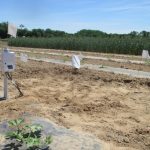
About half of the watermelon fields in our area are not equipped with supplemental irrigation. Watermelon production in these fields is therefore dependent exclusively on rainfall. In fields where supplemental irrigation is available, drip irrigation under black plastic mulch is the most commonly used system. Overhead irrigation through central pivot is also used in some…Read more about Considerations for Irrigation Management in Watermelon Production[Read More]
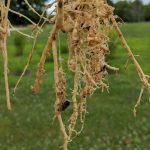
On a sandy hillside in a watermelon field, we noted vines that, from a distance, appeared undersized compared to the vines in the flats. Upon closer inspection, some of the vines had either wilted or a portion of the plant had wilted. The wilted vines had discolored vascular tissue. These vines were affected by Fusarium…Read more about Root-knot Nematode of Watermelon[Read More]
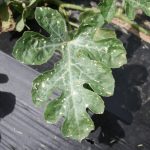
What is causing the spots on the watermelon leaf? A) anthracnose B) early blight C) a contact herbicide The answer is that the leaf above has been affected by a contact herbicide. The herbicide caused lesions upon contacting the leaf. However, there was no growth of the lesion and no yellowing of the leaf…Read more about Answer to Question from Last Issue (6-18-2020)[Read More]
If they have not already, your early season residual herbicides will soon run out of steam. Depending on the crop and production system, you may soon lose the ability to cultivate row middles. Now what? For many vegetable crops, managing emerged weeds is difficult with few postemergence herbicide options. This article will focus on cucurbit…Read more about Considerations for Mid-Season Weed Control in Cucurbits[Read More]