
Purdue Extension presented its first Fruit, Vegetable and Hemp Field Day post-pandemic at the Meigs Ag Center in July 2022. Extension Specialists and Graduate Students presented specialty crop research to 45 attendees. Attendees had only good things to say about the event. ” Great information and research.” “Great variety of experiences and knowledge.” “I felt…Read more about Purdue Fruit and Vegetable Field Day – July 20, 2023[Read More]
Greens and Salad Crops

The 2022 Purdue Small Farm Education Field Day was a big success. Nearly 72% of attendees reported that they learned something new. Nearly half indicated they plan to adopt recommended practices for diversified farming systems, and over a third (36.0%) plan to adopt recommended practices for creating, improving, or strengthening their business. Half (52.0%) indicated…Read more about Small Farm Education Field Day – July 27, 2023[Read More]
The 2023 cover crop survey is underway Adopted from NCR SARE news release, “Farmers: Share Your Thoughts on Cover Crops in the National Cover Crop Survey!“, March 1, 2023 Farmers are invited to share their thoughts on cover crops in an online survey. Why do you plant cover crops…or why don’t you? What do you…Read more about Sustainable Agriculture Research and Education News[Read More]

A common approach in winter production is to allow crops to reach maturity or harvestable size by the end of November. High tunnels are then used as a ‘living refrigerator’ from December to around the middle of February. Crops are harvested as needed in the darkest and coldest periods. This approach, however, did not work…Read more about Low Temperatures in December Hurt January and February Markets[Read More]
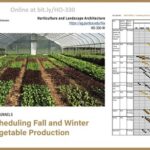
In April we announced a new bulletin “Scheduling Fall and Winter Vegetable Production in High Tunnels”, available from the Purdue Education store at https://edustore.purdue.edu/item.asp?Item_Number=HO-330-W . With the fall/winter high tunnel season underway we are now announcing it again. The publication brings together information collected on farms and research stations in Indiana and Ohio to provide…Read more about Scheduling Fall and Winter Vegetable Production in High Tunnels, Revisited[Read More]
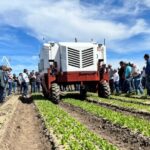
This questionnaire is part of a USDA Specialty Crop Research Initiative (SCRI)-funded proposal (DEVELOPING A NATIONAL TEAM TO OPTIMIZE NON-HERBICIDE WEED MANAGEMENT TECHNIQUES IN COLE AND LEAFY GREEN CROPS) to identify grower interest in novel technology for weed management. Novel technology includes vision-guided sprayers/thinners, steam weeding, and precision mechanical, laser, and electric weeders. It may…Read more about New Questionnaire to Identify Grower Interest in Novel Weed Management Technology[Read More]
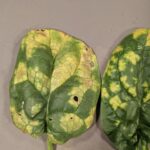
Downy mildew of spinach can be an important disease of spinach. The lesions are often a bright yellow with irregular margins (Figure 1). With time, these lesions can become a light brown. The underside of the lesion is dark black or purple under moist conditions. Under very conducive conditions, sporulation can occur on the top…Read more about Downy Mildew of Spinach[Read More]
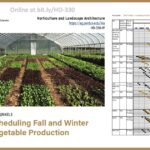
A new bulletin “Scheduling Fall and Winter Vegetable Production in High Tunnels” is available from the Purdue Education store at https://edustore.purdue.edu/item.asp?Item_Number=HO-330-W . The publication brings together information collected on farms and research stations in Indiana and Ohio to provide detailed guidance on scheduling vegetable crops for winter high tunnel production. It includes a fillable scheduling…Read more about Scheduling Fall and Winter Vegetable Production in High Tunnels[Read More]
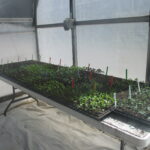
As warm-season crops are harvested, many vegetable farmers start the process of transitioning to cool-season crops. Leafy greens and root vegetables are ready to be planted. High temperature is present across the state recently. The heat stress may affect germination and growth of some of the vegetables. Spinach is probably one of the most heat-sensitive…Read more about Heat Effects on Cool-season Vegetables[Read More]
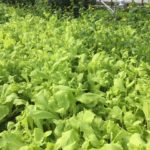
Bolting of crops overwintered in high tunnels is common in the spring. ‘Bolting’ refers to lengthening and blooming of the flowering stalk. Bolting is often a problem because the quality of the marketable part of the plant declines. Also, plants subject to bolting are programmed to die once they complete flowering and seed production so…Read more about Bolting and Blooming in High Tunnels[Read More]