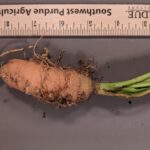
We announced in a previous newsletter article that we are doing a survey to understand the extent of root-knot nematode (RKN) damage on vegetable crops in Indiana. Among the 18 soil samples from high tunnels of 14 farms, RKNs (juvenile or adult) were found in 13 samples at 9 farms. Only 3 farmers knew RKN…Read more about Root-knot Nematode may be a Hidden Problem in High Tunnels[Read More]
Greenhouses & High Tunnels
A new bulletin “Scheduling Fall and Winter Vegetable Production in High Tunnels” is available from the Purdue Education store at https://edustore.purdue.edu/item.asp?Item_Number=HO-330-W . The publication brings together information collected on farms and research stations in Indiana and Ohio to provide detailed guidance on scheduling vegetable crops for winter high tunnel production. It includes a fillable scheduling…Read more about Scheduling Fall and Winter Vegetable Production in High Tunnels[Read More]
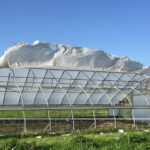
High winds can cause serious damage to high tunnels and greenhouses. Design and construction with this in mind is important to reduce risk. In this article the topic is day to day risk management for a structure that is already constructed. When strong winds threaten, closing up the endwalls and sidewalls can help reduce risk….Read more about National Weather Service Maps Can Aid Decision-Making to Reduce Wind Damage[Read More]
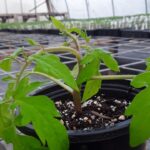
Tomatoes grown in a controlled environment are exposed to different conditions from their original habitats. As a result, some plants may respond to the controlled environment with abnormal symptoms. Leaf and stem curling and distortion are symptoms we may see in the early season in greenhouses (Figure 1). This symptom might be caused by ethylene…Read more about Leaf and Stem Curling on Young Tomato Plants[Read More]
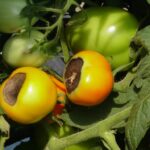
As tomatoes bloom and set fruit it is a good time to review practices for avoiding some common fruit problems. Water management is key to avoiding blossom end rot. Adequate potassium is important to reduce yellow shoulder and internal white tissue. This article provides more information on these topics, and includes some information previously published…Read more about Reducing Blossom End Rot and Yellow Shoulder/Internal White Tissue in Tomato[Read More]
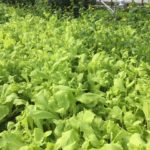
Bolting of crops overwintered in high tunnels is common in the spring. ‘Bolting’ refers to lengthening and blooming of the flowering stalk. Bolting is often a problem because the quality of the marketable part of the plant declines. Also, plants subject to bolting are programmed to die once they complete flowering and seed production so…Read more about Bolting and Blooming in High Tunnels[Read More]
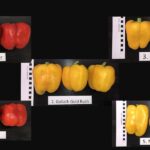
There is still time to select sweet pepper varieties for this summer. During the 2020 growing season, I evaluated a new batch of five sweet bell pepper varieties. I also evaluated five sweet tapered pepper varieties for a second season. All varieties (Table 1, Figures 1 & 2) were grown in a high tunnel at…Read more about Have You Selected Your Sweet Pepper Varieties Yet?[Read More]

A new publication High Tunnel Cucumber Production Guide is available and can be downloaded at https://extension.entm.purdue.edu/publications/ID-521/ID-521-W.pdf This cucumber production guide provides resources and recommendations tailored to the distinctive growing environment of high tunnels. Recommendations are based on research efforts conducted in the Midwest U.S. and include cultivar selection, pruning and trellising systems, insect and mite…Read more about High Tunnel Cucumber Production Guide[Read More]
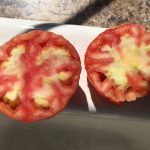
A common problem tomato growers face this time of year are fruit defects caused by high temperatures. Heat stress on tomatoes can lead to reduced yield and abnormal fruit development. The common physiological disorders on fruit development under heat stress include yellow shoulder, internal white tissue, and blotchy ripening. In a recent presentation by Gordon…Read more about Tomato Varieties Differ in Susceptibility to Internal White Tissue Disorder[Read More]
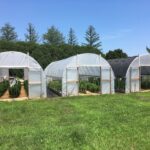
On hot days in the summer, high tunnel growers may wonder whether to place shadecloth on high tunnels. Considering excessive heat inside the structures that may lead to plant stress, blossom drop and unmarketable fruit, there is a rational for doing it. However, it is important to realize the limitations of placing shadecloth on high…Read more about Using Shadecloth on High Tunnels for Tomato and Colored Bell Pepper Production[Read More]