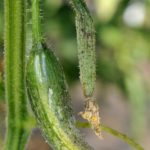
It’s that time of year, where we are prepping high tunnels and getting back into the full swing of production, slowly, here in the Midwest. Many of you have already begun to transplant and may have encountered your first pests on these new crops. Aphids are one that remain a problem in high tunnels, and…Read more about Aphids in High Tunnels[Read More]
Cucurbits
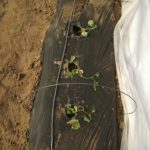
Growers start to plant tomatoes in unheated high tunnels around the end of March in southern Indiana. Around that time, there may still be a few light frosts, or even heavier ones, like the one we just experienced in the past week. With additional help from row covers inside of high tunnels, temperatures normally can…Read more about Check Soil Temperatures before Planting Cucumbers in a High Tunnel[Read More]
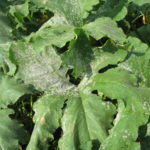
Powdery mildew is a foliar disease of all plants in the cucurbit family. The talc-like symptoms on leaves are relatively easy to identify (Figure 1). More about powdery mildew of cucurbits can be found at this link https://vegcropshotline.org//article/powdery-mildew-of-cucurbits-2/. The remainder of this article is an update. There are several systemic fungicides which are recommended for powdery…Read more about Powdery Mildew of Cucurbits Update[Read More]
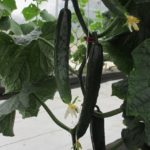
Cucumbers are produced with very different production systems. The ideal cucumber variety for process pickling production is not the variety used for greenhouse production. Choosing the suitable variety for a specific production system then becomes important. Where do you find recommended cucumber varieties for high tunnel production in seed catalogs? Some of the seed catalogs have a category called Greenhouse…Read more about What You Need to Know about Cucumber Varieties for High Tunnel Production[Read More]
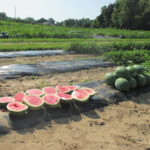
Seedless watermelon variety trials have been conducted at the Southwest Purdue Agricultural Center in Vincennes, IN for more than 20 years. In 2017, we evaluated the performance of 37 standard size seedless watermelon varieties and 4 mini watermelon varieties. This article introduces the top performing varieties in our trial in 2017. Standard size seedless watermelons…Read more about Top Performing Watermelon Varieties in the 2017 Indiana Watermelon Variety Trial[Read More]
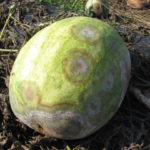
This disease was a serious problem in much of the state this past summer. As a result, I have had many questions about managing this disease. The questions I have been asked have ranged from what do I spray to how does this disease work? Therefore, I have written an article about the symptoms, biology and management…Read more about Phytophthora Blight of Cucurbits[Read More]
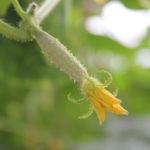
Consumers love cucumbers that are sweet, seedless and have thin skins. They are willing to pay high prices for the long or mini cucumbers sold at grocery stores. These cucumbers are often grown in greenhouses and shipped long distances. It will attract consumers’ attention if greenhouse type cucumbers can be produced locally in high tunnels,…Read more about Are You Interested in Growing Greenhouse Type Cucumbers in High Tunnels, and Targeting for Early Season Production?[Read More]
In the past season, we tested performances of eight specialty melons grown under high tunnel, greenhouse, hydroponic, and conventional field systems. The melon varieties we have tested in our trials include Lilliput, Inspire, Sugar Cube, French Orange, Tasty Bites, Escorial, Savor, and Artemis. Many of these melon varieties are Charentais (Cucumis melo var. cantalupensis). A…Read more about Results of Specialty Melon Variety Trials will be Presented at the Indiana Hort Congress[Read More]
Earlier in August, downy mildew was reported on all cucurbit species in LaPorte County in northwest Indiana and on pumpkins in Starke County (just south of La Porte County). More recently, downy mildew was reported on cucumbers and butternut squash in Knox County in southwestern Indiana. In addition, downy mildew is strongly suspected on cucumbers…Read more about Downy Mildew of Cucurbits[Read More]
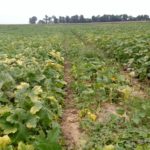
This time of year, I receive many complaints of pumpkin plants with yellow leaves. There can be many reasons why pumpkin plants have yellow leaves. The most common reason for yellow pumpkin leaves doesn’t have anything to do with a disease that can spread from plant to plant. Usually, the reason for the yellow pumpkin…Read more about Yellow Leaves on Pumpkins[Read More]