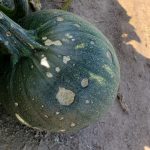
Question: What happened to these fruit? Answer: Hail damage. A storm that happened in middle July brought hail to parts of Indiana. Hail hit small fruit, and damage became pronounced as fruit grow. More information about the damage to vegetable crops can be found in the article Hail Damage published in Vegetable Crops Hotline Issue…Read more about Answer to Question from Last Issue (8-13-2020)[Read More]
Found 1707 Articles
USDA announces more eligible commodities for Coronavirus Food Assistance Program (CFAP), and the deadline to apply for the program was extended to September 11th. The following additional commodities are now eligible for CFAP: Specialty Crops – aloe leaves, bananas, batatas, bok choy, carambola (star fruit), cherimoya, chervil (french parsley), citron, curry leaves, daikon, dates, dill, donqua…Read more about Update of the CFAP program on Aug. 11[Read More]
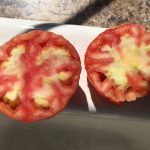
A common problem tomato growers face this time of year are fruit defects caused by high temperatures. Heat stress on tomatoes can lead to reduced yield and abnormal fruit development. The common physiological disorders on fruit development under heat stress include yellow shoulder, internal white tissue, and blotchy ripening. In a recent presentation by Gordon…Read more about Tomato Varieties Differ in Susceptibility to Internal White Tissue Disorder[Read More]
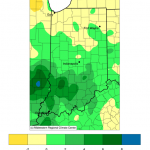
Rain moved across Indiana earlier this week, bringing much-needed precipitation to the northern counties. Unfortunately, the 30-day rainfall totals are still up to two inches below normal (Figure 1). The southern and southwestern counties are well above normal and could likely use a break for the next few days! Good news for those tiring of…Read more about Monitoring Potential Evapotranspiration Across Indiana[Read More]
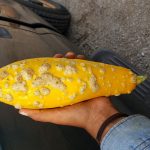
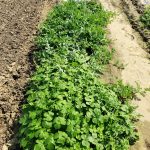
Watermelon is growing in this bed, but something went wrong. What happened? Answer: The weed morningglories are taking over watermelons. Morningglories have become one of the most severe weeds observed in the watermelon field in southern Indiana. More information about this weed can be found in the article Morningglories in this issue of Vegetable Crops…Read more about Answer to Question from Last Issue (7-30-2020)[Read More]
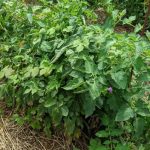
Genus: Ipomoea sp. Species: Ivyleaf: Ipomoea hederacea Entireleaf: Ipomoea hederacea integriuscula Tall: Ipomoea purpurea Pitted: Ipomoea lacunosa Morning glories are among the most troublesome weeds in many cropping systems in the Midwest. They are difficult to control due to their fast growth, large seed size, and impenetrable seed coat. Morning glories get their name because…Read more about Morningglories[Read More]
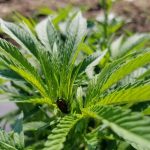
Since hemp is still a relatively new crop in our state, we’re excited to learn more about the insect communities that are associated with this crop! For the last six weeks or so, my lab team, led by Master’s student Zach Serber (Figure 1), has been scouting outdoor CBD hemp plants for insects and their…Read more about Observations of Insect Communities on Outdoor CBD Hemp[Read More]
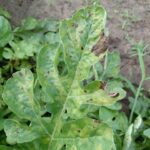
Downy mildew has been observed in LaPorte County in northern Indiana on cucumber. In addition, downy mildew on cucumber has been reported in southern Kentucky and on watermelon in the Kansas City area of Kansas. Growers in northern Indiana should manage for downy mildew on valuable cucurbit crops (Figure 1). Growers throughout the state should…Read more about Cucurbit Downy Mildew[Read More]

The Small Farm Education Field Day and Webinar Series will take place 12:00 -1:10 pm EST, July 30 to Aug. 14, 2020. Register at https://tinyurl.com/y5ahtrow. After you register, a Zoom link will be emailed to you. If you have any questions, please contact Petrus Langenhoven at (765) 496-7955 or plangenh@purdue.edu
Purdue University prohibits discrimination against any member of the University community on the basis of race, religion, color, sex, age, national origin or ancestry, genetic information, marital status, parental status, sexual orientation, gender identity and expression, disability, or status as a veteran. This material may be available in alternative formats. 1-888-EXT-INFO Disclaimer: Reference to products in this publication is not intended to be an endorsement to the exclusion of others which may have similar uses. Any person using products listed in this publication assumes full responsibility for their use in accordance with current directions of the manufacturer.