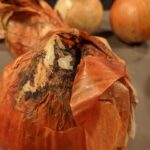
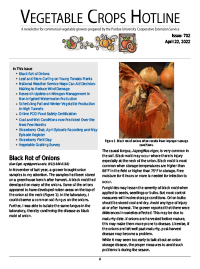
In November of last year, a grower brought onion samples to my attention. The samples had been stored on a greenhouse bench after harvest. A black mold had developed on many of the onions. Some of the onions appeared to have developed rotten areas on the top of the onion at the neck (Figure 1)….Read more about Black Mold of Onions[Read More]
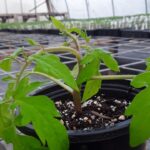
Tomatoes grown in a controlled environment are exposed to different conditions from their original habitats. As a result, some plants may respond to the controlled environment with abnormal symptoms. Leaf and stem curling and distortion are symptoms we may see in the early season in greenhouses (Figure 1). This symptom might be caused by ethylene…Read more about Leaf and Stem Curling on Young Tomato Plants[Read More]
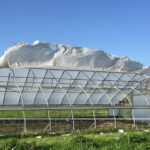
High winds can cause serious damage to high tunnels and greenhouses. Design and construction with this in mind is important to reduce risk. In this article the topic is day to day risk management for a structure that is already constructed. When strong winds threaten, closing up the endwalls and sidewalls can help reduce risk….Read more about National Weather Service Maps Can Aid Decision-Making to Reduce Wind Damage[Read More]
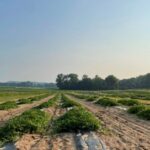
A large proportion of watermelon acres in Indiana are not currently using drip irrigation. Farmers may choose not to use drip irrigation because precipitation is usually abundant in most years for watermelon production. There is a desire to reduce costs and/or fear that over-irrigation may increase the risk of mature watermelon vine decline, a disease…Read more about Research Update on Nitrogen Management in Non-Irrigated Watermelon Production[Read More]
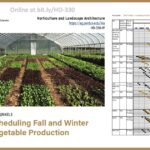
A new bulletin “Scheduling Fall and Winter Vegetable Production in High Tunnels” is available from the Purdue Education store at https://edustore.purdue.edu/item.asp?Item_Number=HO-330-W . The publication brings together information collected on farms and research stations in Indiana and Ohio to provide detailed guidance on scheduling vegetable crops for winter high tunnel production. It includes a fillable scheduling…Read more about Scheduling Fall and Winter Vegetable Production in High Tunnels[Read More]
Course: Online PCQI Certification – Watermelon Packing Dates: May 5 & May 6, 2022 Times: 8:00 am – 6:00 pm EST Online Platform: Zoom Cost: $1000.00 each participant To register: pcqiclasses@gmail.com or text 561-261-9747 Course Info: Kiley will lead a VIRTUAL but interactive training session (via ZOOM) across two days from 8:00 am – 6:00 pm each day….Read more about Online PCQI Food Safety Certification[Read More]
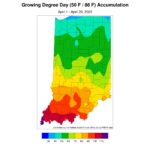
On the third Thursday of every month, the national Climate Prediction Center releases their 3-month climate outlook for temperature and precipitation. These outlooks are presented as the level of confidence (i.e., probability of occurrence) for conditions to be above or below normal. Since last fall, these outlooks have been consistently favoring above-normal temperatures and precipitation…Read more about Cool and Wet Conditions now Predicted Over the Next Few Months[Read More]

Listen to Strawberry Chat Episode 2. The episode was recorded on April 6, 2022, it featured Dr. Bruce Bordelon talking about spring activities for the strawberry matted-row system. Are you interested in participating live in the next strawberry chat? It will be 12:00 -1:00 pm, May 4, 2022. Our guests will be Dr. Janna Beckerman…Read more about Strawberry Chat, April Episode Recording and May Episode Register[Read More]
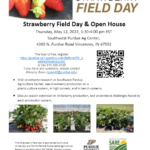
Time: Thursday, May 12, 2022, 1:30-4:00 pm EST Location: Southwest Purdue Ag Center, 4369 N. Purdue Rd, Vincennes, IN, 47591 Register: https://purdue.ca1.qualtrics.com/jfe/form/SV_dgK5N8Ws9m2cJWC, or call 812-886-0198 Visit strawberry research at Southwest Purdue Agriculture Center; see strawberry production on a plastic culture system, in high tunnels, and in bench systems. Discuss season extension in strawberry production, and…Read more about Strawberry Field Day[Read More]

Tell us about your opinions on vegetable grafting practices All growers are eligible whether you use vegetable grafting practices or not. Researchers at the University of Florida, in collaboration with Clemson University, North Carolina State University, The Ohio State University, Pennsylvania State University, Kansas State University, Washington State University, University of Arizona, University of California, Davis, and USDA – Agricultural Research…Read more about Vegetable Grafting Survey[Read More]
Purdue University prohibits discrimination against any member of the University community on the basis of race, religion, color, sex, age, national origin or ancestry, genetic information, marital status, parental status, sexual orientation, gender identity and expression, disability, or status as a veteran. This material may be available in alternative formats. 1-888-EXT-INFO Disclaimer: Reference to products in this publication is not intended to be an endorsement to the exclusion of others which may have similar uses. Any person using products listed in this publication assumes full responsibility for their use in accordance with current directions of the manufacturer.